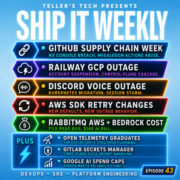
Trusted tools are having a rough week. A popular VS Code extension reportedly helped expose thousands of GitHub internal repositories. Megalodon hit thousands of public repos with poisoned commits and GitHub Actions workflow abuse. Railway had a platform-wide outage after Google Cloud incorrectly suspended its production account. Discord dropped 17% of active sessions during a Kubernetes migration.
And AWS is changing SDK retry behavior, which sounds boring until you remember retries are how your app behaves when the world is already on fire. The theme this week is simple. The tools that we trust most are becoming some of our riskiest production dependencies. I'm Brian Teller from Teller's Tech, and this is Ship It Weekly.
Welcome back to Ship It Weekly, the show where we look at DevOps, SRE, cloud, platform, and security stories that matter when you are the person who eventually has to keep the thing running.
This week, we're starting with GitHub supply chain risk from two directions: a compromised VS Code extension tied to a GitHub internal repo breach and the Megalodon campaign abusing public repos and CI/CD workflows then we'll talk about railway's gcp account suspension outage discord's voice outage postmortem AWS changing SDK retry defaults, and a RabbitMQ AWS plugin issue that accidentally shipped debug code into production builds.
In the lightning round, we'll hit OpenTelemetry Graduation, Claude Code RCE, GitLab Secrets Manager, Google Cloud AI Spend Caps, and a Redshift Python driver RCE. And the human closer is about trusted tools because the systems we trust most are often the ones we forget to threat model. So let's get into it. First up, GitHub had a rough supply chain week. The developer toolchain got hit from multiple directions.
The first story is the Nx Console VS Code extension compromise. Reporting says a malicious version of the Nx Console extension was published and that the extension was later tied to a breach involving thousands of GitHub internal repositories. StepSecurity says the compromised version was Nx Console 18.95.0 and that the root cause involved a contributor's GitHub token being scraped in a prior supply chain attack.
The Hacker News reported that roughly 3,800 GitHub internal repositories were exposed after a GitHub employee device was compromised through the malicious extension.
Now, I'm not saying every VS Code extension is evil, but every VS Code extension is still code running next to the repos you clone, the terminal you use, and sometimes the tokens you forgot were still hanging around, which is not exactly a low-trust environment. A lot of developers install extensions like browser tabs. That looks useful. That has a nice icon. That has a lot of installs. Sure, why not?
And normally that feels fine until an extension update becomes an initial access path. That is the real lesson. The developer workstation is part of the production attack surface now, not because it serves customer traffic, because it touches the things that eventually do. Repos, secrets, CI/CD, cloud credentials, deployment tooling, package publishing, SSH keys.
Kubeconfigs all the fun little artifacts we pretend are carefully managed until somebody runs `ls ~/.aws` and the room gets quiet. Then there's Megalodon. Security researchers reported a campaign hitting more than 5,500 public repositories with malware -laden commits, stealing CI/CD secrets like AWS and Google Cloud keys. SSH private keys, and Kubernetes configs. That makes this more than a GitHub story.
It's a reminder that CI/CD is not just where code gets tested. It is where trust gets converted into artifacts. If a workflow has cloud credentials, package publishing tokens, signing keys, or deployment authority, then a compromised workflow is not just a dev problem. It is a release system compromise. The takeaway is not ban all extensions or never use GitHub Actions. That's not serious.
The takeaway is to treat developer tooling as production-adjacent infrastructure. Review extensions with broad file, terminal, or workspace access. Use short -lived credentials where you can. Keep cloud keys out of CI when OIDC works. Lock down GitHub Actions permissions. Require review on workflow changes. And please.
Do not let every workflow run with full write access because that was easier during the first setup. A trusted extension, a trusted repo, and a trusted workflow can all become part of the same attack path. That's the part that matters. Next up, Railway published an incident report about a platform-wide outage caused by Google Cloud. Incorrectly suspending Railway's production account.
That sentence alone is enough to make most cloud engineers sit up a little straighter. Railway says the outage started on May 19th when Google Cloud incorrectly placed their production account into a suspended status. That took Railway's API, dashboard, control plane, databases, and GCP-hosted compute infrastructure offline. And then it got more interesting.
Railway also runs workloads on Railway Metal and AWS burst-cloud environments. And those workloads initially stayed up. But Railway's edge proxies relied on a GCP-hosted control plane API to populate routing tables. So when route caches expired, the outage cascaded beyond GCP.
Workloads that were still technically running became unreachable because the network control plane could no longer resolve routes to active instances. At peak impact, Railway says all workloads across all regions were unreachable. And that is the story. Not just Google Cloud suspended an account. The real story is that multi-cloud did not save the system because the control plane dependency was still in the hot path.
That is where architecture diagrams get too optimistic. You can draw AWS over here and GCP over there. Metal in another box. Some arrows, maybe a nice little mesh diagram. And suddenly, everybody feels resilient. But resilience is not about how many providers appear on the diagram. It is about what has to work during a failure.
If your data plane in AWS still needs a control plane API in GCP to route traffic, then GCP is still in the hot path. If your failover region needs the primary region's identity system to approve failover, then the primary region is still in the hot path. If your emergency deploy process depends on the same CI/CD platform that is currently broken, then congratulations.
You have invented a circular dependency with branding. The strongest thing in Railway's writeup is that they owned it. They said that they take responsibility. For the architectural decisions that allowed one upstream provider action to cascade into a platform-wide outage. That's the right posture.
Customers do not care whether the thing that broke was technically Google, Railway, GitHub, Stripe, AWS, or a squirrel with a networking certification. They see your product. So when you say multi-cloud, ask what dependency is still centralized? What service discovers routes? What service holds identity? What API does the edge need? What happens when cached state expires?
And what dependency do you only discover when the provider account disappears and everyone suddenly becomes very interested in architecture diagrams? Multicloud is not magic. Sometimes it is just single cloud with extra invoices. Third story. Discord published a really good postmortem. On its March 25th voice outage. The title is perfect. You've got too much mail.
Because this outage wasn't just Kubernetes killed some pods. It was a chain reaction where a routine infrastructure change hit a stateful system, dropped a large number of sessions, and downstream systems got overwhelmed by the recovery behavior. Discord says voice and video suffered major degradation. For a little over three hours. Users were mostly unable to start or join calls and saw an awaiting endpoint message.
The trigger came during a Kubernetes migration for Discord's Elixir services. They were tuning session management service resources and pod counts. As Kubernetes applied the change, it terminated 50 % of the pods in one zone. Since sessions were balanced across three zones, about 17% of active sessions were ungracefully stopped. That alone is not great. But the cascading part is the real lesson.
Discord’s systems use Elixir GenServer processes, and those processes have mailboxes. When all those sessions vanished, other processes received a flood of messages saying sessions were down. That caused reconnect behavior, rate limit pressure, memory spikes. Gateway problems, and eventually voice and video routing issues.
This is the kind of postmortem that I love because it shows how real outages are usually not one failure. They are interaction failures. Kubernetes did what it was told. The session service had handoff logic. The rate limit existed. The downstream services were designed for normal load, but the shape of the change produced a workload the system was not tuned for.
That is the part people miss when they say, why didn't they just autoscale? Because auto scaling is not a magic undo button for we just invalidated 17% of active sessions and created a reconnect storm. Sometimes the bottleneck is not CPU. Sometimes it's mailbox length, back pressure, downstream fanout. Or one angry queue quietly becoming the main character. The practical takeaway is migration safety.
When you move stateful systems into Kubernetes, think beyond pod termination. What does the rest of the system do when this pod terminates? Who gets notified? Who retries? Who reconnects? Who queues messages? Who gets overloaded trying to help? Graceful shutdown is not just a pod lifecycle feature. It is a system behavior. If you are doing Kubernetes migrations for stateful services, test the ugly cases.
Kill more than one pod. Drain a zone. Watch downstream queues. Look at reconnect behavior. Because production does not ask if the change was routine. It asks if the system was ready. Fourth story, AWS is changing retry behavior across AWS SDKs and tools. And I know that that sounds like the kind of story that you would normally skip because it has the emotional energy of a configuration footnote.
But retry defaults are invisible infrastructure. They affect latency, error rates, load during outages, and how your app behaves. When AWS services are already struggling. AWS says the updated retry behavior is available now behind opt-in and will become the default in November, 2026. The updated behavior changes how standard and adaptive retry modes handle failures.
AWS is making standard mode the default for SDKs that previously defaulted to legacy mode, adding retry quotas where they didn't exist. Changing backoff timing and treating transient errors differently from throttling errors. One big change is that transient error retries cost more retry quota than before.
The idea is that during sustained outages, the SDK fails faster instead of endlessly retrying and adding pressure to a service that is already unhealthy. That is good, but it can still surprise you. Retries are one of those things most teams do not think about until an incident. Your code says call S3. The SDK says it'll handle some retries. Your app says, great, I'll pretend that that was one request.
Then the service starts throwing errors and suddenly request latency, thread usage, connection pools, client CPU, and downstream load all depend on retry behavior you may never have explicitly configured. Retries can save you from transient failures. Retries can also turn a partial outage into a client -side traffic storm wearing a helpful little hat. So the takeaway is simple.
Do not wait until November 2026 to discover how your app behaves. Pick a non -production workload. Opt in with the new environment flag. Look at latency. Look at error surfaces. Look at max attempts. Look at throttling behavior.
Look at long-polling clients like SQS consumers and figure out whether your app depends on old retry behavior without anyone realizing it because nothing says fun on call rotation like finding out your retry strategy was inherited from 2018 and load-tested by hope. Fifth story, let's talk about RabbitMQ, debug code, secrets, and cloud cost blast radius.
AWS published a security bulletin for CVE -2026 -9133 in the rabbitmq-aws plugin. The plugin resolves AWS ARNs in RabbitMQ's broker configuration at startup and can fetch things like TLS certificates, private keys, passwords, and other secrets from AWS services. The issue is that debug code in the plugin's ARN resolver was accidentally shipped in production builds.
A debug ARN scheme accepted by a validation endpoint could allow a remote authenticated user to read arbitrary files accessible to the RabbitMQ process. That is not good. AWS recommends upgrading to rabbitmq-aws 0 .2 .1, patching forked code, and rotating secrets stored in files. The RabbitMQ process could read. This is a specific bug, but the pattern is broad.
Debug code in production should make everyone briefly stop blinking because debug paths often bypass the normal shape of the system. They inspect the thing directly. They validate a thing in a way production code usually does not.
And then somehow that path makes it into a build where a real user or attacker can reach it this also pairs with a separate aws bedrock cost story from Reddit where a user described attackers using exposed access keys from an ec2 instance to run about $14,000 of Claude calls in 24 hours That second story is a Reddit report, so I would not treat it like a formal incident report, but as a pattern it is extremely believable cloud credentials plus AI services can become a very fast money fire.
Security and FinOps are blending together. Compromised cloud keys used to mostly mean crypto mining, data access, or infrastructure abuse. Now they can also mean someone burning through model inference or AI API calls at a rate that makes finance start typing in all caps. The takeaway is not complicated. Scope credentials. Use roles instead of long -lived access keys where possible. Watch unusual service usage.
Put budgets and anomaly detection around AI services. Rotate secrets when file-read issues appear. And remember that authenticated user does not mean safe user. Small bugs get expensive when the process can read secrets and the secrets can spend money. Now let's do a quick lightning round. First, OpenTelemetry graduated from the CNCF. This is a huge milestone.
OpenTelemetry is now basically the de facto standard for vendor -neutral telemetry across traces, metrics, and logs. But the operator warning is still the same. The collector is production plumbing. Graduation does not mean that every collector upgrade is safe, every processor config is harmless, or every telemetry pipeline is suddenly boring. Standardization helps, but you still need rollout strategy.
Config validation, load testing, and a plan for what happens when the thing that reports on production becomes the thing breaking production. Second, Claude Code had a security issue. I'm keeping this short because we have covered Claude code and agent security a lot lately. But the pattern matters. AI coding tools are not just editors. They can have filesystem access, repo context, terminals, deeplinks.
Commands, and workflow integration. So when those tools have parsing bugs, deeplink bugs, or command execution paths, the risk is not theoretical. The developer environment is becoming another agent runtime, and agent runtimes need threat models. Third, GitLab 19.0 introduced GitLab Secrets Manager in public beta. This is a good direction.
Secrets closer to the pipeline, scoped to jobs, governed through the same platform people already use for CI/CD, that does not solve every secret manager problem, but it does acknowledge reality. A lot of secrets risk lives in CI/CD because CI/CD is where systems need credentials to do work. Treating pipeline secrets as first -class objects is better than pretending a masked variable named prod token is a strategy.
Fourth, Google Cloud is rolling out hard spend caps for AI services. This is a FinOps story, but it is also a reliability story. If a budget cap pauses API traffic when spend hits a limit, that can protect you from a surprise bill. It can also become an availability event if your product depends on that API. So hard caps are useful, but they need operational design. Who gets alerted before the cap?
What degrades gracefully? What is customer facing? And what do you want more? A hard outage or a hard invoice? Sometimes the answer depends on the day. Fifth, Amazon Redshift Python driver had an RCE issue. AWS reported CVE -2026 -8838 in the Redshift Python driver, where a rogue server could execute commands on a user's data warehouse client.
That is a good reminder that database clients are part of your execution boundary too. Not every RCE starts on the server. Sometimes the client connects to the wrong thing, trusts the wrong response, and becomes the thing that gets owned. So patch the driver, watch connection targets, and remember that it is just a client library is usually how the story starts, not how it ends.
The human closer this week is about trusted tools the riskiest systems are not always the mysterious ones sometimes they are the familiar ones the extension everyone installs the workflow nobody reviews the retry behavior nobody configured the plugin that shipped with debug code the control plane api that seemed fine because the cache bought you an hour trusted tools become dangerous when trust turns into invisibility That does not mean that every tool is bad.
It means that trust should have an expiration date. Every so often you need to ask, what does this tool have access to? What can it change? What happens if it is compromised? What happens if it disappears? What happens if it retries differently? What happens if the cache expires? That is not paranoia. That is being the person who has to answer the incident channel when everyone else is asking, how could this happen?
The staff and principal engineer job is often about seeing the shape of the dependency. Noticing when a developer tool is actually a production path. When a retry default is actually outage behavior. When a multi -cloud architecture still has one hot dependency. When a plugin can read secrets. When the thing that everyone trusts has become the thing nobody questions. The takeaway is not to stop trusting tools.
You cannot run modern systems that way. The takeaway is to make trust visible. Map the permissions. Review the workflows. Scope the credentials. Test the failure path. Patch the clients. Constrain the plugins. And look at your boring dependencies like they might be production infrastructure. Because they probably are. That's it for this week of Ship It Weekly.
We covered the GitHub supply chain week with Nx Console and Megalodon. Railway's GCP account suspension outage. Discord's voice outage postmortem, AWS SDK retry behavior changes, the RabbitMQ AWS plugin file-read issue, and a lightning round on OpenTelemetry, Claude Code, GitLab Secrets Manager, Google AI Spend Caps, and Redshift Python Driver RCE.
If this episode was useful, follow or subscribe wherever you are watching or listening. If you're on YouTube, hit subscribe. If you are in a podcast app, Follow the show there. And if you know someone on a DevOps, SRE, platform security or engineering leadership team who is dealing with supply chain risk, cloud dependencies, retries or trusted tooling, send this one to them.
It helps the show grow and it helps me keep making this kind of content for people who actually live with these systems. You can find the weekly brief at OnCallBrief.com and more episodes and this week's show notes on ShipItWeekly .fm. I'm Brian Teller from Teller's Tech. Thanks for listening.
And remember, if your trusted tool can install code, trigger CI, route traffic, retry requests, read secrets, or burn cloud money, it is not just a tool anymore. It is part of production. So maybe treat it like it.
Scroll inside the box to read the full transcript, or expand for a larger view.