On Call Brief – Week of July 5–11, 2026
This week's top stories
1. JadePuffer Demonstrates How AI Agents Can Automate Ransomware Attack
- Category: Community
- What happened: Security researchers have documented a proof-of-concept ransomware campaign called JadePuffer that was executed entirely by an AI agent using large language models, demonstrating that LLMs can now automate complex multi-stage cyberattacks without human intervention. This represents a significant evolution in attack automation capabilities, as the AI agent was able to autonomously perform reconnaissance, exploitation, lateral movement, and deployment phases that previously required human decision-making and oversight. SRE and DevOps teams should review their detection and response capabilities to ensure monitoring systems can identify automated attack patterns and anomalous tool usage that may indicate AI-driven attacks, particularly focusing on rapid sequential actions and toolchain behaviors that differ from typical human attacker timing. Organizations should also assess whether their security controls rely too heavily on assumptions about human-paced attacks and consider implementing rate limiting and behavioral analysis that can detect machine-speed reconnaissance and exploitation attempts.
- Worth reading: The automation of ransomware attacks by AI agents indicates a significant shift in threat landscape, potentially increasing the frequency and sophistication of attacks on production systems. Operators should be aware of this trend and consider enhancing their security measures.
- Sources: Security Boulevard Newsletters
2. Microsoft, Google and Cloudflare just made 2029 the new quantum deadline
- Category: Community
- What happened: Microsoft, Google, and Cloudflare have moved the deadline for adopting quantum-safe cryptography from 2030 to 2029, citing advancements in quantum computing that could pose risks sooner than expected. This shift emphasizes the need for organizations to begin preparations for a transition to post-quantum cryptography, which is recognized as a multi-year engineering effort. The urgency is driven by the potential arrival of cryptographically relevant quantum computers, necessitating early action to mitigate risks and costs associated with the transition.
- Worth reading: Organizations must accelerate their plans for adopting quantum-safe technologies to meet the new 2029 deadline, which could impact security strategies and resource allocation. Delaying preparations could lead to increased risks and costs.
- Source: The New Stack
3. Cloudflare: 2 service incidents (Issues with network performance in North America, Elevated number of errors in
- Category: Deep Dive
- What happened: Cloudflare experienced two distinct regional incidents affecting their network between July 3 and July 6. The first incident involved network performance degradation across North America that required multiple days to identify and resolve, though specific technical details about the root cause were not disclosed in the status updates. Separately, customers routing through Cloudflare's Munich point of presence encountered elevated 4XX and 5XX error rates during a 12-minute window on an unspecified date between 05:07 and 05:19 UTC, which was subsequently resolved. Operators using Cloudflare services should review their monitoring and logs for these timeframes to assess any impact on their applications, though no ongoing action is required as both incidents have been resolved.
- Takeaway: This incident may have affected users relying on Cloudflare's services in North America, potentially leading to degraded performance or connectivity issues during the outage period.
- Sources: Cloudflare Status
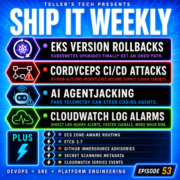
4. Upgrade Amazon EKS clusters with confidence using Kubernetes version rollbacks - An undo button for Kubernetes
- Category: Deep Dive
- What happened: Amazon EKS now supports Kubernetes version rollbacks, allowing operators to revert to a previous version if an upgrade causes issues. This feature aims to reduce the risks associated with upgrades, which often require extensive preparation and can lead to downtime if not managed carefully.
- Takeaway: This rollback capability provides a safety net for EKS upgrades, potentially reducing downtime and operational stress during version changes. It allows teams to respond more flexibly to issues that arise post-upgrade.
- Source: AWS via Last Week in AWS
5. NetNut Proxy Network Disrupted, 2 Million Infected Devices Cut Off
- Category: Deep Dive
- What happened: A joint operation involving Google, the FBI, and other partners disrupted the NetNut residential proxy network, which had provided cybercriminals access to millions of compromised Android devices. This operation cut off access to approximately 2 million infected devices, including smart TVs and streaming boxes.
- Takeaway: The disruption of the NetNut proxy network may affect organizations relying on similar proxy services for legitimate purposes, as well as increase scrutiny on device security and the potential for compromised devices in networks.
- Source: Security Boulevard (FeedBurner mirror)
6. Miggo Security Adds Abiliy to Detect Linux Privilege Escalation Vulnerability
- Category: Community
- What happened: Miggo Security has released a detection tool that identifies exploitation attempts targeting a recently disclosed Linux kernel privilege escalation vulnerability, though the specific CVE number and affected kernel versions are not provided in the available information. The tool monitors and alerts on potential exploitation activities to enhance security posture. SRE teams should monitor for updates from Miggo Security or their Linux distribution vendors regarding the specific vulnerability details, affected versions, and recommended patching timelines. Until more specifics are available, operators should ensure their standard kernel update processes are current and consider deploying the Miggo detection tool if compatible with their environment to gain visibility into potential exploitation attempts.
- Worth reading: This tool could help operators enhance their security posture by detecting potential exploitation attempts of critical vulnerabilities in Linux systems.
- Sources: Security Boulevard Newsletters
7. Speaking of shitty Google decisions, it turns out your Maps key picked up Gemini permissions while you weren't
- Category: Community
- What happened: The article discusses how Google Maps API keys inadvertently gained Gemini permissions without user consent, raising concerns about security and unexpected billing. The author highlights the lack of communication regarding this change and warns users to be cautious with their API keys, especially if they are exposed in client-side code.
- Worth reading: This change could lead to unauthorized access and unexpected charges if API keys are not properly managed. Operators should review their API key permissions and ensure they are not exposing sensitive keys in client-side code.
- Source: Medium via Last Week in AWS
8. Researchers Uncover Magecart Attack Leveraging Blockchain Infrastructure
- Category: Community
- What happened: Security researchers have identified a Magecart digital skimming campaign that uses the Ethereum blockchain as command-and-control infrastructure to target e-commerce websites globally. The attack injects malicious JavaScript into online retail platforms to steal payment card data and customer information during checkout processes. Operators running e-commerce platforms should immediately review their web application code for unauthorized JavaScript injections, implement Content Security Policy headers to restrict script execution, and monitor for unexpected blockchain-related network connections. Organizations should also ensure their web application firewalls are configured to detect common Magecart patterns and conduct regular integrity checks on client-side code, particularly in payment processing flows.
- Worth reading: This attack method could lead to increased vulnerabilities for e-commerce platforms, necessitating enhanced security measures to protect customer data and transactions.
- Sources: Security Boulevard Newsletters
9. Fake Bug Report Shows AI Coding Agents Can Be Turned Into an Enterprise Attack Path
- Category: Deep Dive
- What happened: Researchers have identified a new attack method called 'agentjacking' that targets AI coding assistants by embedding malicious instructions within fake bug reports. This technique was tested on AI tools like Claude Code, Cursor, and Codex, which were able to retrieve compromised error logs, potentially exposing enterprises to security risks.
- Takeaway: This attack vector highlights vulnerabilities in AI coding tools that could be exploited in production environments, necessitating increased scrutiny and security measures around the use of AI in software development.
- Source: Security Boulevard (FeedBurner mirror)
10. Uncover new performance insights using Amazon detailed performance statistics on Windows
- Category: Community
- What happened: Amazon EC2 Windows instances now offer detailed performance statistics for both Amazon EBS and Instance Store, enabling real-time monitoring of key metrics like latency, throughput, and IOPS. This enhancement allows operators to proactively identify and address performance bottlenecks. The new metrics provide sub-minute granularity and can be accessed via the NVMe device attached to the EC2 instance. A sample solution is provided to demonstrate how to use these statistics for monitoring and troubleshooting storage performance, particularly for latency-sensitive applications.
- Worth reading: The introduction of detailed performance statistics can significantly improve the ability to monitor and optimize storage performance on EC2 Windows instances. This could lead to enhanced application reliability and performance, especially for workloads sensitive to I/O interruptions.
- Source: AWS Compute Blog
CVE & Security
1. CVE-2026-14471 - Authenticated SQL injection in the metrics-service retention policy subsystem of mcp-gateway-registry
- Category: Security / Patch
- What happened: CVE-2026-14471 is a critical SQL injection vulnerability in the metrics-service retention policy subsystem of the Amazon mcp-gateway-registry. An authenticated remote user can exploit this vulnerability by supplying a crafted table_name value, allowing them to execute arbitrary SQL queries against the metrics database. This can lead to unauthorized access to stored data, including sensitive information like API keys, and the ability to delete or modify data.
- Do this Monday: This vulnerability poses a significant risk to any deployment using affected versions of the mcp-gateway-registry, as it allows authenticated users to manipulate the database, potentially leading to data breaches or loss.
- Source: AWS Security Bulletins
2. Novee Uncovers Cordyceps: The Latest Threat to CI/CD Pipelines
- Category: Security / Patch
- What happened: Novee has identified a new supply chain security flaw named Cordyceps that poses significant risks to CI/CD pipelines. This vulnerability allows unauthenticated users to hijack workflows and gain control over code repositories of major companies like Microsoft and Google. The flaw exploits weaknesses in CI/CD workflows, which are often not treated as security-critical, leading to potential command injection and credential theft. The rise of AI coding agents further complicates the issue by perpetuating insecure patterns across repositories.
- Do this Monday: The Cordyceps vulnerability highlights critical security gaps in CI/CD processes that could lead to unauthorized code execution and credential theft. Organizations must reassess their CI/CD security practices to mitigate these risks, especially given the ease of exploitation by unauthenticated users.
- Source: DevOps.com
3. Opera GX Flaw Let Malicious Sites Auto-Install Mods to Steal Data From Visited Pages
- Category: Security / Patch
- What happened: A vulnerability in Opera GX allowed malicious websites to automatically install browser add-ons, enabling data theft from visited pages without user interaction. Researchers demonstrated that they could extract a user's full Gmail address through this exploit. Opera has released a patch for the flaw and reported no evidence of exploitation in the wild.
- Do this Monday: This vulnerability could have led to unauthorized access to sensitive user data, highlighting the importance of keeping browsers updated and being cautious with add-ons. The patch should be applied to mitigate potential risks.
- Source: Thehackernews via The Hacker News (security)
4. PostgreSQL: 42.7.12, 1.30.0
- Category: Security / Patch
- What happened: PostgreSQL JDBC driver version 42.7.12 has been released to address CVE-2026-54291, a vulnerability that allows silent downgrade of SCRAM-SHA-256-PLUS authentication to weaker variants by bypassing channel binding requirements. Operators using PostgreSQL JDBC drivers should upgrade to 42.7.12 to prevent potential authentication downgrade attacks, particularly in environments where channel binding is configured for enhanced security. Separately, CloudNativePG 1.30.0 introduces a new DatabaseRole Custom Resource Definition for GitOps-based PostgreSQL role management and implements a Lease-based primary election mechanism to improve failover safety. Organizations running CloudNativePG should evaluate upgrading to 1.30.0 for the improved failover mechanisms and security enhancements, though the specific security fixes were not detailed in the available information.
- Do this Monday: This release is critical for users relying on channel binding for secure connections, as it mitigates a significant security risk. Operators should update to version 42.7.12 to ensure protection against potential man-in-the-middle attacks that exploit this vulnerability.
- Sources: PostgreSQL News
5. SkillCloak Lets Malicious AI Agent Skills Evade Static Scanners with Self-Extracting Packing
- Category: Security / Patch
- What happened: Researchers have developed a technique called SkillCloak that allows malicious AI agent skills to evade detection by static scanners. This method successfully bypassed over 90% of the tested scanners, highlighting vulnerabilities in current security measures against AI-related threats. The team also created a runtime checker that can identify most of these malicious skills.
- Do this Monday: This development raises concerns about the effectiveness of existing security measures for AI systems, potentially leading to increased risks of malware in AI applications - operators should consider enhancing their detection capabilities to address these vulnerabilities.
- Source: Thehackernews via The Hacker News (security)
Releases
1. China-Linked Threat Group Expands Attacks on Southeast Asia’s Critical Infrastructure
- Category: Release
- What happened: Cybersecurity researchers have identified a China-linked threat group, CL-STA-1062, that is now targeting critical infrastructure organizations in Southeast Asia, including electricity and water providers, as well as government entities. This marks a shift from their previous focus on web-hosting infrastructure in Taiwan.
- Do this Monday: Increased attacks on critical infrastructure could lead to potential disruptions in services and heightened security risks for organizations in Southeast Asia. Operators should assess their security posture and readiness against such targeted threats.
- Source: Security Boulevard (FeedBurner mirror)
2. Enforce least-privilege authorization in multi-agent AI chains using Cedar
- Category: Release
- What happened: This article discusses the importance of enforcing least-privilege authorization in multi-agent AI systems to prevent unauthorized actions through delegation. It introduces a three-layer policy model using Cedar, an open-source authorization language, deployed on AWS. The model evaluates authorization at each hop in a delegation chain, ensuring that agents do not exceed their authorized capabilities. The implementation utilizes AWS Lambda functions for processing and enforcing these policies.
- Do this Monday: Implementing this three-layer authorization model can significantly enhance security in multi-agent AI systems, reducing the risk of privilege abuse. Teams working with AI systems should consider integrating Cedar to manage authorization effectively.
- Source: AWS Security Blog
3. Insignary Closes SBOM Accuracy Gap With Binary-Level Clarity for Regulatory Risk
- Category: Release
- What happened: Insignary has introduced a binary-first platform called Insignary Clarity that enhances software composition analysis (SCA) by analyzing the actual binaries deployed rather than just the declared components. This approach addresses the growing concern over unmanaged open-source dependencies and the accuracy of Software Bills of Materials (SBOMs), which are becoming regulatory requirements. The platform aims to provide better visibility into vulnerabilities and compliance risks associated with open-source components, especially in AI-generated code environments.
- Do this Monday: The introduction of Insignary Clarity could significantly affect how organizations manage their software supply chains and compliance with emerging regulations around SBOMs. By validating software at the binary level, teams can better understand and mitigate risks associated with open-source components, which is crucial as regulatory scrutiny increases.
- Source: DevOps.com
4. Your Worker can now have its own cache in front of it
- Category: Release
- What happened: Cloudflare has launched Workers Cache, a tiered caching solution that sits in front of Cloudflare Workers to serve cacheable requests directly from Cloudflare's cache infrastructure before they reach Worker code. This feature allows operators to reduce CPU usage and associated costs by avoiding Worker execution for requests that can be satisfied from cache, though specific configuration details were not fully provided in the announcement. SRE teams running applications on Cloudflare Workers should evaluate whether their workloads have cacheable request patterns that would benefit from this caching layer and review the configuration options to implement caching policies. The feature represents a shift in Cloudflare's Workers architecture, moving from a purely edge-compute model to one that includes traditional CDN-style caching as a first-class component, according to the Cloudflare Blog announcement.
- Do this Monday: The introduction of Workers Cache can significantly improve performance and reduce costs for applications using Cloudflare Workers. By caching responses at the edge, it minimizes the need for Workers to execute for cacheable requests, which can lead to lower CPU time and faster response times for users.
- Sources: Cloudflare Blog, Blog Cloudflare via TLDR DevOps
5. Claude Reaches GA on Microsoft Foundry: European Enterprises Cannot Deploy It
- Category: Release
- What happened: Claude models are now generally available on Microsoft Foundry, featuring Azure-native billing and governance. However, there is no European data zone available, which means that European enterprises, particularly in regulated sectors like banking and healthcare, cannot deploy it for production use due to data residency concerns.
- Do this Monday: The lack of a European data zone for Claude models on Microsoft Foundry limits deployment options for organizations in Europe, especially those in regulated industries that require strict data residency compliance.
- Source: InfoQ DevOps
Also this week
Community reads
11. Amazon CloudWatch supports creating alarms from log queries - Alarming on logs without first sacrificing a goat to
- Category: Community
- What happened: Amazon CloudWatch now allows users to create alarms directly from log queries, simplifying the process of monitoring logs. However, this feature comes with a caveat: users will incur costs based on the amount of data scanned by these scheduled queries, which could lead to unexpected billing increases during error spikes.
- Worth reading: This change could affect production monitoring strategies, as operators need to be mindful of query frequency to avoid high costs associated with log data scanning.
- Source: AWS via Last Week in AWS
12. Cloudflare launched Workers Cache, a tiered caching system that sits in front of Workers and can eliminate CPU
- Category: Community
- What happened: Cloudflare has launched Workers Cache, a new tiered caching system that sits in front of Cloudflare Workers to serve cached responses before worker code executes. This architecture change can eliminate CPU charges for cached requests by preventing unnecessary worker invocations, directly reducing compute costs while improving response times for cacheable content. Operators currently using Cloudflare Workers for applications with cacheable responses should evaluate implementing Workers Cache to optimize both performance and billing, particularly for high-traffic endpoints serving static or semi-static content. The feature is now available to Workers customers and can be configured through the standard Workers caching API.
- Worth reading: The introduction of Workers Cache could significantly lower operational costs for applications relying on Cloudflare Workers by reducing CPU usage. This change may affect how developers optimize their serverless functions and manage caching strategies.
- Sources: Atlassian via TLDR DevOps
13. Cloudflare launched Workers Cache, a tiered caching system that sits in front of Workers and can eliminate CPU
- Category: Community
- What happened: Cloudflare has introduced Workers Cache, a new tiered caching system that operates as a layer in front of Cloudflare Workers to serve cached responses before invoking worker functions. This caching layer is designed to reduce CPU usage and associated compute costs by preventing unnecessary worker executions when cached content can satisfy requests. SRE teams running applications on Cloudflare Workers should evaluate implementing Workers Cache to optimize their compute spending, particularly for workloads with cacheable content that currently trigger worker invocations on every request. The system provides both performance improvements through faster cache hits and cost efficiency by eliminating billable CPU time for cached responses.
- Worth reading: The introduction of Workers Cache could significantly impact performance and cost management for applications using Cloudflare Workers by reducing CPU charges through effective caching.
- Sources: Pgdog via TLDR DevOps, Spacelift via TLDR DevOps, GitHub via TLDR DevOps
14. DevOps'ish 316: ClickHouse Eats o11y, Vint Cerf Bows Out, Podman Breaks Things, and More
- Category: Community
- What happened: The CNCF's Kepler project is undergoing a re-architecture to improve power monitoring accuracy in Kubernetes environments, addressing limitations in the current implementation's measurement capabilities. The Linux Foundation has launched Akrites, a new initiative specifically designed to protect open-source software from AI-generated vulnerabilities and attacks, responding to emerging threats in the development pipeline. ClickHouse is gaining traction as an observability backend, offering performance advantages over traditional solutions for storing and querying telemetry data. Additionally, recent Podman updates have introduced breaking changes that operators should be aware of when upgrading (source: DevOps'ish newsletter issue 316).
- Worth reading: The changes in Kepler could affect power monitoring strategies in Kubernetes environments. The launch of Akrites may influence how teams approach open-source security. ClickHouse's performance advantages could lead to cost savings in observability solutions. Podman's breaking changes necessitate careful review before upgrading, particularly for existing deployments.
- Sources: DevOps'ish
Lightning links
- How IAG accelerated service-to-service communication with Amazon VPC Lattice (AWS Networking Blog) -- IAG improved microservices communication by implementing Amazon VPC Lattice for direct connections.
- 6 security settings every GitHub maintainer should enable this week (TLDR DevOps) -- GitHub Security Lab recommends essential security settings for maintainers to enhance repository safety.
- Dynata’s journey to lower TCO and faster modernization with AWS Database Savings Plans (AWS Database Blog) -- Dynata achieved cost optimization and modernization by adopting AWS Database Savings Plans.
- Vercel Now Lets You Deploy Any Dockerfile Straight to Production (Cloud Native Now) -- Vercel's new feature allows direct deployment of Dockerfiles as serverless functions with autoscaling.
- LLM Access Control Framework: Cost, Safety, Access, and Audit Considerations (dev.to (DevOps tag)) -- This article outlines key considerations for managing access to large language models effectively.
- A Better CI Check for AWS Approval Emails (dev.to (DevOps tag)) -- The article presents a CI/CD pattern for validating AWS approval emails using Docker and disposable addresses.
- When TLS 1.3-only broke everything behind Akamai (dev.to (DevOps tag)) -- An incident highlights the challenges of TLS policy mismatches between Akamai and backend servers.
- Microsoft Replaces OpenAI, Anthropic With Own AI in Some Apps (TLDR AI) -- Microsoft's shift to in-house AI solutions marks a strategic move away from third-party dependencies.
Human Stories
The JadePuffer demonstration landed this week like a stone in still water, and the ripples it created touch almost everything else we're looking at. When AI can orchestrate a ransomware campaign autonomously, and Google can quietly grant your Maps API keys Gemini permissions you never asked for, we're watching two sides of the same coin - the acceleration of autonomous systems outpacing the governance frameworks we built for simpler times. Microsoft, Google, and Cloudflare moving up their quantum deadline by a full year tells us the same story from a different angle: the future we planned for is arriving faster than expected, and our risk models need constant recalibration. What strikes me most is how NetNut's disruption and these new EKS rollback capabilities represent our collective immune response - we're finally building undo buttons and coordinating takedowns because we've learned that complexity and speed demand both better recovery mechanisms and stronger coalitions. The real thread here isn't just that threats are evolving or that our tools are getting more powerful, it's that the distance between theoretical risk and operational reality keeps collapsing, and we need to collapse our response times right along with it.
Also worth reading
When TLS 1.3-only broke everything behind Akamai (dev.to (DevOps tag))
An incident occurred when requests to a backend nginx server stopped due to a mismatch in TLS policies between Akamai and an External Load Balancer (LB). The LB was set to TLS 1.3 only, while Akamai was configured to negotiate down to older versions. This caused the TLS handshake to fail, leading to
Windows Device ID in Hacking Case Raises Questions About Enterprise Telemetry (Security Boulevard Newsletters)
A Windows device identifier was crucial in tracking an alleged hacker, prompting concerns about the extent to which Microsoft’s telemetry can link activities to individual PCs. This incident highlights potential privacy implications for enterprise telemetry systems.
TuxCare Warns AI Will Weaponize Vulnerability Chains (Security Boulevard Newsletters)
TuxCare discusses the potential for AI to exploit vulnerability chains, raising concerns about the implications for security. The interview highlights how AI could automate the discovery and exploitation of vulnerabilities, making it easier for malicious actors to launch attacks.