Try reloading the player or open this episode directly on YouTube.
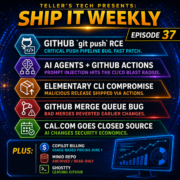
This episode of Ship It Weekly discusses the evolving role of developer tools in production environments. Brian covers critical vulnerabilities like GitHub's git push RCE, AI prompt injection, and supply chain incidents, highlighting the need for enhanced security measures in
Now Playing
GitHub RCE, AI Agent Prompt Injection, and the New Reality: Your Developer Toolchain Is Production Now
Ship It Weekly
0:0025:08
Chapters
Jump to a section in this episode.
Speed & share
Transcript
Developer tooling used to feel like the safe
part of the system. Production was the scary
place. The database, the cluster, the load balancer,
the pager. And then everything around that was
just tooling. GitHub, CICD, merge queues, package
publishing, code review bots, AI agents. But
that line is getting harder to defend. Because
when the tooling can merge code, publish artifacts,
leak secrets, spend money, or decide what gets
shipped, it is not just sitting beside production
anymore. It is part of production. And this week,
that idea showed up everywhere. Hey, I'm Brian
Teller. I work in DevOps and SRE, and I run Teller's
Tech. This is Ship It Weekly, where I filter
the noise and focus on what actually changes
how we run infrastructure and own reliability.
Show notes and links are on shipitweekly .fm.
If this show's been useful, follow it wherever
you listen. Ratings help way more than they should.
And if you are watching on YouTube, subscribe
there too. We have six main stories today, then
the lightning round, and we'll wrap with the
human closer. We're starting with GitHub's critical
Git Push remote code execution vulnerability,
including the AI reverse engineering angle from
Wiz. Then we'll talk about prompt injection against
AI agents tied into GitHub workflows. After that,
Elementary's CLI supply chain incident, where
a GitHub actions workflow became the path to
a malicious release. Then GitHub's April 23rd
Merge Queue regression. Then cal .com going closed
source, which is probably the most argument -starting
story in this set. And finally, GitHub Copilot
moving to usage -based billing because AI tooling
is becoming a governance and cost management
problem, not just a productivity experiment.
Then in the lightning, we'll hit MinIO, Ghostty,
Docker -hardened images, and Azure DevOps security
updates. Story one. GitHub's GitPush RCE is a
toolchain wake -up call. Let's start with GitHub.
GitHub disclosed a remote code execution vulnerability
in the GitPush pipeline. The issue affected GitHub
.com, GitHub Enterprise Cloud, GitHub Enterprise
Cloud with Data Residency, Enterprise Managed
Users, and GitHub Enterprise Server. GitHub says
Wiz reported the bug through the bug bounty program
on March 4th. GitHub reproduced it internally
within about 40 minutes, fixed GitHub .com in
under two hours, and says it found no evidence
of exploitation. That is the reassuring part.
The uncomfortable part is the shape of the bug.
The vulnerability involved user -supplied Git
push options. Those push options ended up influencing
internal metadata passed between GitHub services.
Because of how that metadata was formatted, an
attacker could inject extra fields that a downstream
service treated as trusted internal data. And
once user input can shape trusted internal metadata,
things get ugly fast. GitHub says the researchers
showed they could override the environment where
the push was processed, bypassing sandboxing
around hook execution, and ultimately execute
arbitrary commands on the server handling the
push. That is a lot hiding behind the phrase
Git push. And that is why this belongs in a DevOps
and SRE conversation, not just a security newsletter.
Every team treats Git as normal plumbing. Humans
push code. Bots push code. Automation responds
to pushes. CI kicks off. Release workflows start.
Security scanners run. Deployment paths wake
up. But behind that one command is a hosting
platform. Internal service boundaries. Hook execution.
Sandboxing. Audit logs. And identity. That is
infrastructure. For GitHub .com and enterprise
cloud users, GitHub says the platform was patched
and no customer action is needed. For GitHub
enterprise server customers, this is a patch
now situation. GitHub specifically recommends
upgrading supported G -H -E -S releases and reviewing
audit logs for suspicious push operations. But
the bigger story may be how Wiz found it. Dark
reading covered the AI -assisted reverse engineering
side. Wiz used AI tooling to help analyze GitHub
Enterprise Server, understand compiled binaries
and internal service behavior, and find a bug
that historically may have taken weeks or months
to uncover. They reportedly went from the idea
to working exploit in under 48 hours. That is
the part that should stick with us. Not because
AI found a bug, like the robot woke up and became
a hacker. The real story is that AI lowered the
cost of understanding complex systems. A lot
of software has been protected informally by
being annoying. Hard to reverse engineer. Hard
to understand. Too much glue. Too many binaries.
Too many internal assumptions. That was never
real security, but it was friction. And friction
matters. If AI removes enough of that friction,
then systems that were probably fine because
nobody will spend the time become more interesting
targets. So the takeaway is not panic. It is
that boring security engineering matters more
when discovery gets faster. Input validation.
Trust boundaries. Least privilege. Patch velocity.
Audibility. Because when the cost of finding
bugs drop, the cost of sloppy assumptions go
up. Story 2. Prompt injection is now in the CI
-CD blast radius. Next up, AI agents and GitHub
actions. The register covered research showing
prompt injection attacks against AI agents from
Anthropic, Google, and Microsoft tied to GitHub
workflows. The basic shape is pretty simple.
AI agents read GitHub data, pull request titles,
issue bodies, issue comments, review comments,
markdown, the stuff developers and contributors
write all day. So if an attacker can place malicious
instructions into that data and an agent later
processes it with access to tools or secrets,
the attacker may be able to steer the agent.
In the Claude case, researchers showed that a
malicious PR title could influence the bot and
leak credentials into a review comment. With
Gemini, issue comments and prompt injection were
used to expose an API key. With GitHub Copilot
Agent, malicious instructions could be hidden
in an HTML comment that humans would not see
in rendered markdown. The victim assigns the
issue to Copilot, but the payload is already
sitting there in the context. The researchers
demonstrated theft of Anthropic and Gemini API
keys, multiple GitHub tokens, and potentially
any secret exposed to the GitHub Actions Runner
environment. That last phrase is the one I care
about. The GitHub Actions Runner environment.
Because this is not just an AI story. This is
a CICD story. If your agent runs in GitHub Actions,
and GitHub Actions has access to tokens, deployment
credentials, package publishing rights, cloud
permissions, Slack webhooks, or JIRA credentials,
then prompt injection becomes part of that blast
radius. The researcher called this comment and
control, which is a play on command and control.
And it fits. The attacker may not need malware.
They may not need an external callback. They
may not need to trick a human into clicking anything.
They can write data into GitHub, let automation
read it, and let the automation leak the secret
back into GitHub. That is a nasty little loop.
And this is where I think teams are a little
too cautious about agents. A code review bot
should not have more access than it needs. An
issue summarizer should not have repository write
access. A documentation bot does not need cloud
keys. And if you are passing untrusted GitHub
content into an agent that can use tools, run
commands, or read secrets, that is not a harmless
productivity flow. That is untrusted input hitting
an execution environment. We have had that category
of problem for decades. AI did not invent it.
AI just made the parser weird. Story 3. Elementary's
CLI incident is the supply chain story in miniature.
Now let's talk about elementary. Elementary Data
published a security incident report for a malicious
release of the elementary open source Python
CLI version 0 .23 .3. On April 24th, a malicious
CLI package was published to PyPI, and a malicious
Docker image was published to their registry.
Those artifacts were not produced by the elementary
team. According to elementary, the attacker opened
a PR with malicious code and exploited a script
injection vulnerability in one of their GitHub
actions workflows to publish the release. That
is the modern supply chain anxiety loop in one
story. A pull request. A workflow vulnerability.
a release -looking artifact, PyPI, Docker, and
downstream users who now have to assume any credentials
accessible to the environment where that CLI
ran may have been exposed. Elementary removed
the malicious release, published a safe 0 .23
.4, removed the vulnerable workflow, rotated
affected credentials, and moved the OIDC authentication
where possible. That response sounds pretty solid,
but the attack path is the real lesson. A lot
of teams still think of GitHub Actions as a convenience
layer. But for many projects, GitHub Actions
is the release authority. It builds containers.
It publishes packages. It signs things. It pushes
to registries. It decides what gets shipped.
So if that workflow has script injection, broad
permissions, long -lived tokens, or too much
trust in PR -controlled input, then your release
system can become the attack path. The question
is not only do you trust your source code? It
is also do you trust the automation that turns
source code into artifacts? Those are not the
same question anymore. You can have a clean main
branch and a vulnerable release workflow. You
can have signed releases and a compromised signing
path. You can rotate app credentials and still
forget that the package publisher token has been
sitting in CI forever. So the practical playbook
is boring but important. Check workflow permissions.
Avoid long -lived publishing tokens where OIDC
is available. Be careful with shell interpolation
from PR titles, branch names, issue comments,
tags, and commit messages. Split, build, and
publish. Protect release environments. And threat
model GitHub Actions like production. Because
if GitHub Actions can publish your package, it
is production. It might not serve customer traffic,
but it controls customer trust. Story four, GitHub's
merge queue regression is a control plane reliability
story. Next one is also GitHub, but from a reliability
angle. On April 23rd, GitHub had a merge queue
regression. GitHub says whole requests merged
through merge queue using squash merge produced
incorrect merge commits when a merge group contained
more than one pull request. In some affected
cases, changes from previously merged PRs and
prior commits were accidentally reverted by later
merges. GitHub says that 658 repositories and
2 ,092 pull requests were affected. No data was
lost because the commits still existed in Git.
But affected default branches ended up in an
incorrect state. And GitHub could not safely
repair every repository automatically. That is
a painful incident. And it is painful because
merge queues exist to reduce risk. That is the
whole point. They are supposed to make high -change
environments safer. Instead of everyone racing
to merge against a moving base branch, the queue
group changes, validates them, and lands them
in a more orderly way. So when that control plane
gets a bad behavior, it creates a weird kind
of incident. Not the site is down. Not the database
is corrupted. But the mechanism we trust to preserve
correctness just produced a branched state that
is not what we think it is. That is subtle. And
subtle is dangerous. Because if a deploy fails
loudly, you know. If an API goes red, you know.
If a merge queue quietly reverts earlier changes,
you might not notice until the wrong code is
already in production. The practical takeaway
is not don't use merge queues. I still like merge
queues. The takeaway is that any environment
with merge authority needs SRE thinking. Good
audit trails. Easy ways to identify what changed.
Detection when a branch state does something
weird. Clear ownership when the thing that protects
main becomes the thing that damages main. Merge
queues, feature flag systems, CI schedulers,
artifact registries, deployment orchestrators,
GitOps controllers. These are control planes.
They may not be in the request path, but they
shape what production becomes. Story five. Cal
.com going closed source is the argument everyone
will want to have. Now for the spicy one. Cal
.com announced that it is going closed source.
They said that after five years as open source
champions, they are moving the production code
base closed because AI has changed the security
landscape. Their argument is basically this.
In the past, exploiting an application required
skilled humans. time, and patience. Now AI can
be pointed at an open -source codebase and used
to systematically scan for vulnerabilities. Cal
.com says that being open -source is increasingly
like giving attackers the blueprints to the vault.
They are keeping an open version available as
cal .diy under the MIT license. But they say
that the production Cal .com codebase has diverged,
including rewrites in areas like authentication
and data handling. I have mixed feelings on this
one. On one hand, I understand the concern. This
week's GitHub and Wiz story gives some support
to the idea that AI can make vulnerability discovery
faster and cheaper. If you run a SaaS product
handling sensitive calendar data, authentication
flows, integrations, and customer information,
it is not crazy to worry about AI -assisted vulnerability
mining. On the other hand, closed source equals
safer is not a clean argument. Closed source
software still gets reversed. Closed source software
still has bugs. Closed source software can lose
the benefit of external review. And hiding code
is not the same as securing it. So I would not
frame this as cal .com is right or cal .com is
wrong. The better framing is that AI is putting
real pressure on the business and security model
of commercial open source. For maintainers, open
source can mean transparency, community, contributions,
and trust. For customers, it can mean self -hosting,
auditability, and less vendor lock -in. For attackers,
it can mean a searchable map of the systems.
And for a commercial company, it may mean all
of those things at once, plus support burden,
vulnerability reports, hosted customer risk,
and investor pressure. That tension is not new.
AI just makes it louder. For platform teams,
the takeaway is not stop using open source. That
would be ridiculous. The takeaway is stop treating
project governance and licensing as background
noise. When a project changes its source model,
repo model, release model, or commercial posture,
that is supply chain signal. You do not have
to panic, but you should notice. Story six, co
-pilot usage -based billing makes AI a governance
problem. Last main story. GitHub Copilot is moving
to usage -based billing on June 1st. GitHub says
all Copilot plans will transition to GitHub AI
credits. Instead of counting premium requests,
plans will include a monthly credit allotment,
and usage will be calculated based on token consumption,
including input, output, and cached tokens. Base
subscription prices are not changing, according
to GitHub. Code completions and next edit suggestions
stay included. But agentic usage, longer sessions,
This episode is really about one idea: the developer toolchain is production now.
For a long time, a lot of engineering teams treated GitHub, CI/CD, merge queues, release workflows, package publishing, and internal bots as the stuff around production. Important, sure, but still somehow separate from the “real” production systems.
That line is getting harder to defend.
If a workflow can publish to PyPI or Docker, that workflow is part of production. If a merge queue can change what lands on main, that merge queue is part of production. If an AI agent can read issues, comment on PRs, run inside GitHub Actions, and touch secrets, that agent is part of production. If Copilot usage can consume credits and Actions minutes, that is not just a developer productivity tool anymore. It is now part of cost governance too.
The GitHub git push RCE story is the clearest example this week. Most engineers think of git push as plumbing. It is just the thing you do before everything else starts. But behind that command is a whole chain of trust: GitHub’s internal services, hook execution, sandboxing, metadata handling, repository permissions, and auditability. When that path has a critical bug, it reminds you that the “boring” developer workflow is actually a privileged infrastructure path.
The AI reverse-engineering angle makes it even more interesting. The takeaway is not that AI magically finds all vulnerabilities now. That is too simplistic. The real point is that AI lowers the cost of understanding complex systems. Things that used to be protected by being tedious, opaque, or expensive to reverse engineer may not stay that way. That does not mean open source is doomed or closed source is safe. It means bad assumptions get cheaper to find.
That ties directly into the Cal.com story. I do not think “AI exists, therefore we must close source everything” is a clean argument. Closed source software still has bugs. It can still be reversed. And open source still provides real benefits around transparency, trust, adoption, self-hosting, and external review. But I do think Cal.com is pointing at a real pressure point. AI changes the economics of vulnerability discovery, and commercial open source companies are going to feel that pressure in weird ways.
The prompt injection story is probably the most practical warning for teams right now. A malicious PR title, issue comment, or hidden Markdown/HTML comment is not just text if an AI agent reads it and has access to tools, tokens, or a runner environment. That is untrusted input entering an execution path. We already know how to think about that category of problem. AI just makes the parser less predictable and the failure mode stranger.
The Elementary CLI compromise is the same lesson from a supply-chain angle. GitHub Actions is not “just CI” when it can publish packages. At that point, it is a release system. If it has broad permissions, script injection risks, or long-lived tokens, then your release authority may be weaker than your source code protections.
And the GitHub merge queue regression is the reliability version of the same theme. Merge queues are supposed to reduce risk, and I still think they are valuable. But any system with merge authority is a control plane. When it fails, it may not look like an outage. It may look like main quietly ending up in the wrong state. That is harder to detect, and in some ways more dangerous.
The common thread is that engineering teams need to relabel these systems correctly.
A CI workflow that publishes artifacts is a release system.
A merge queue is a source-control control plane.
An AI agent with repo access is a principal with tools.
A package registry is part of your customer trust chain.
A usage-based AI assistant is part of FinOps.
An archived repo or a project leaving GitHub is a supply-chain signal.
None of that means teams should panic. It means the casual mental model needs to go.
Developer tooling is where code becomes software. It is where ideas become artifacts. It is where humans, bots, agents, credentials, and automation all meet. That makes it one of the most important production surfaces we have, even if it does not serve customer traffic directly.
The better way to think about reliability now is not just “are the servers up?”
It is also: can we trust the path that gets code to those servers?
📝 Notes
Show Notes
This episode of Ship It Weekly is about the developer toolchain becoming part of production. Brian covers GitHub’s critical git push RCE, AI-assisted reverse engineering, prompt injection against AI agents in GitHub workflows, Elementary’s malicious CLI release, GitHub’s merge queue regression, Cal.com going closed source, and Copilot moving toward usage-based billing. Plus: MinIO’s repo archive, Ghostty leaving GitHub, Docker Hardened Images, and Azure DevOps security updates.


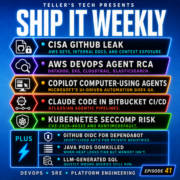
This episode is really about one idea: the developer toolchain is production now.
For a long time, a lot of engineering teams treated GitHub, CI/CD, merge queues, release workflows, package publishing, and internal bots as the stuff around production. Important, sure, but still somehow separate from the “real” production systems.
That line is getting harder to defend.
If a workflow can publish to PyPI or Docker, that workflow is part of production. If a merge queue can change what lands on main, that merge queue is part of production. If an AI agent can read issues, comment on PRs, run inside GitHub Actions, and touch secrets, that agent is part of production. If Copilot usage can consume credits and Actions minutes, that is not just a developer productivity tool anymore. It is now part of cost governance too.
The GitHub
git pushRCE story is the clearest example this week. Most engineers think ofgit pushas plumbing. It is just the thing you do before everything else starts. But behind that command is a whole chain of trust: GitHub’s internal services, hook execution, sandboxing, metadata handling, repository permissions, and auditability. When that path has a critical bug, it reminds you that the “boring” developer workflow is actually a privileged infrastructure path.The AI reverse-engineering angle makes it even more interesting. The takeaway is not that AI magically finds all vulnerabilities now. That is too simplistic. The real point is that AI lowers the cost of understanding complex systems. Things that used to be protected by being tedious, opaque, or expensive to reverse engineer may not stay that way. That does not mean open source is doomed or closed source is safe. It means bad assumptions get cheaper to find.
That ties directly into the Cal.com story. I do not think “AI exists, therefore we must close source everything” is a clean argument. Closed source software still has bugs. It can still be reversed. And open source still provides real benefits around transparency, trust, adoption, self-hosting, and external review. But I do think Cal.com is pointing at a real pressure point. AI changes the economics of vulnerability discovery, and commercial open source companies are going to feel that pressure in weird ways.
The prompt injection story is probably the most practical warning for teams right now. A malicious PR title, issue comment, or hidden Markdown/HTML comment is not just text if an AI agent reads it and has access to tools, tokens, or a runner environment. That is untrusted input entering an execution path. We already know how to think about that category of problem. AI just makes the parser less predictable and the failure mode stranger.
The Elementary CLI compromise is the same lesson from a supply-chain angle. GitHub Actions is not “just CI” when it can publish packages. At that point, it is a release system. If it has broad permissions, script injection risks, or long-lived tokens, then your release authority may be weaker than your source code protections.
And the GitHub merge queue regression is the reliability version of the same theme. Merge queues are supposed to reduce risk, and I still think they are valuable. But any system with merge authority is a control plane. When it fails, it may not look like an outage. It may look like main quietly ending up in the wrong state. That is harder to detect, and in some ways more dangerous.
The common thread is that engineering teams need to relabel these systems correctly.
A CI workflow that publishes artifacts is a release system.
A merge queue is a source-control control plane.
An AI agent with repo access is a principal with tools.
A package registry is part of your customer trust chain.
A usage-based AI assistant is part of FinOps.
An archived repo or a project leaving GitHub is a supply-chain signal.
None of that means teams should panic. It means the casual mental model needs to go.
Developer tooling is where code becomes software. It is where ideas become artifacts. It is where humans, bots, agents, credentials, and automation all meet. That makes it one of the most important production surfaces we have, even if it does not serve customer traffic directly.
The better way to think about reliability now is not just “are the servers up?”
It is also: can we trust the path that gets code to those servers?