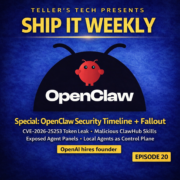
Special: OpenClaw Security Timeline and Fallout: CVE-2026-25253 One-Click Token Leak, Malicious ClawHub Skills, Exposed Agent Control Panels, and Why Local AI Agents Are a New DevOps/SRE Control Plane (OpenAI Hires Founder)
Try reloading the player or open this episode directly on YouTube.
In this special episode, Brian analyzes the OpenClaw security incident, highlighting its implications for platform teams dealing with local AI agents.
Now Playing
Special: OpenClaw Security Timeline and Fallout: CVE-2026-25253 One-Click Token Leak, Malicious ClawHub Skills, Exposed Agent Control Panels, and Why Local AI Agents Are a New DevOps/SRE Control Plane (OpenAI Hires Founder)
Ship It Weekly
0:0018:49
Chapters
Jump to a section in this episode.
Speed & share
Transcript
Picture this. You're on your laptop, coffee in
hand, doing the normal start of day shuffle.
Slack, email, calendar, Jira, whatever. And you
click a link. Not a sketchy link, not free crypto
nonsense. It's a link that looks like documentation.
Or a GitHub issue. or a skill page or even a
link your agent surfaced for you because it was
helping and that one click is enough to hand
over the keys to the thing you've been testing
a local ai agent that can run commands read files
hit apis and act on your behalf not in the cloud
not in a sandbox you forgot existed on your actual
machine with your actual credentials that's what
we're talking about today Hey, I'm Brian from
Teller's Tech, and this is Ship It Weekly. Be
sure to visit shipitweekly .fm for all of the
show notes and past episodes. Today is a special.
No lightning round, no normal format. This is
a special episode on OpenClaw. OpenClaw isn't
just another AI tool. It's a preview of what
a lot of us are about to be dealing with at work,
whether we like it or not. Local agents, real
tools, real credentials, real consequences. And
OpenClaw is basically the clearest case study
we've had so far for what happens when autonomy
meets messy reality. security boundaries, plugin
ecosystems, web UIs, token handling, and humans
doing human things. All right. Let's set the
stage. If you somehow miss the hype, OpenClaw
is an agent platform you can run locally. The
pitch is simple. AI that actually does things.
Not just chat, not just suggestions. It can connect
to your tools and take action. It can manage
your calendar, triage email, message people,
hit APIs, automate little workflows. The kind
of stuff we all hack together with scripts. Except
now, it's driven by a model that can reason through
a task. And the locally part is what made it
explode because a bunch of people are sick of
handing their entire inbox, calendar, or internal
docs to some random SaaS agent. Running it on
your own machine feels like control. And look,
I get the appeal. It's the same reason we like
local dev environments, self -hosted runners,
internal tooling. You want ownership, you want
knobs, and you want to see what it's doing. But
here's the thing. when you run an agent locally
you're not just running software you're running
an operator a little automation brain that wants
to access everything files tokens browsers ssh
cloud clis whatever you let it touch so the question
becomes what are we actually building here because
from a devops and sre lens this is not an app
this is a control plane and control planes have
two roles one they always end up with scary permissions
because otherwise they can't do the job. And
two, they always end up becoming the target.
And over the last few weeks, OpenClaw basically
speed ran both of those roles. Here is the situation
in one line. People installed local agents. gave
them real access and the ecosystem immediately
started getting hit like it was npm plus a browser
admin panel plus remote management tool which
yeah because that's what it is so you had multiple
things happening at once you had a serious vulnerability
story where a web ui plus token handling plus
browser behavior created a one -click path to
take over You had a marketplace story, where
skills or extensions turned into a malware delivery
channel. You had the usual people expose local
admin things to the internet story, because of
course they did. And then on top of that, you
now have the meta story, the creator getting
hired by OpenAI, which is basically a signal
flare that the big players are going all in on
agents. So it's not just, wow, this one tool
had issues. It's the entire category is now real.
And we need to talk about how we treat it like
adults. Because if your engineers start running
agents on workplace machines with access to AWS,
GitHub, CLI, and maybe even payment methods,
you don't have a toy problem. You have a production
security problem that just moved onto laptops.
Let's talk about the vulnerability angle without
getting into exploity details. The headline version
is, there was a high severity issue where a crafted
link could result in token leakage and then gateway
compromise, leading to remote code execution.
And if you are thinking, wait, how does a link
do that if the agent is local? That's the important
part. A lot of people hear local and their brain
goes, cool, so it's behind local host, so I'm
safe. But local host is not a magical security
boundary. It's a networking convenience. And
the browser is the ultimate helpful idiot in
security stories. It will happily make requests
from your machine to other places on your behalf.
So if you have a local control panel in your
browser, and that control panel can talk to a
privileged local service, you have tokens involved.
Congratulations, you have reinvented a whole
class of web security problems. This is the part
where DevOps folks sometimes roll their eyes
because it sounds like front -end security. But
it's not front -end security, it's admin plane
security. It's the same category as an internal
Kubernetes dashboard, a Jenkins UI, a self -hosted
GitHub runner with a web panel, a secrets UI,
or an Argo UI. If it can trigger actions, it's
an attack surface. And with OpenClaw, the core
lesson isn't, wow, they had a bug. The lesson
is agents collapse trust boundaries. Because
the UI isn't just showing you data, it's holding
the steering wheel. So if a browser session can
be tricked into handing over a token or connecting
somewhere it shouldn't or trusting something
it shouldn't, the impact is way bigger than someone
saw a page. The impact is you just handed someone
an operator account for something that can execute
on your machine, which is basically the worst
version of developer laptop compromise. Because
now it's not even a human making the decisions.
It's an automation system that can be nudged.
So practical takeaway here. If you are running
OpenClaw or anything like it, you need to patch
fast, obviously. But also, stop thinking local
equals safe. Local just means the blast is on
you first. And that sounds dramatic, but it's
true. The minute you have a privileged local
service plus a browser UI plus tokens, you are
in the same design space as a mini control plane.
So you need to treat it that way. Now, let's
talk about the part that will feel extremely
familiar to anyone who has lived through supply
chain headaches. OpenClaw has skills. There are
extensions, add -ons, whatever you want to call
them. And there was a wave of malicious skills
showing up, including hundreds flagged in reporting.
This is the oldest story on the internet. A popular
platform shows up, a registry shows up, a bunch
of people install things because, hey, it's open
source and the community is building cool stuff.
And attackers go, oh, sick, an executable distribution
channel with confused users. The difference here
is the payload. With normal package ecosystems,
malware tends to be about stealing tokens, crypto,
SSH keys, browser data, that kind of thing. With
agent ecosystems, the malware doesn't just steal,
it can also steer. Because skills don't just
sit there. They influence what the agent can
do, what it can access, and what kinds of actions
it will take. And the social engineering is painfully
predictable. It's stuff like, install this prerequisite,
run this command real quick, paste this into
your terminal. If you've ever watched someone
get popped by a fake homebrew tap or a sketchy
curl pipe bash, you already know the vibe. Now,
layer in the agent angle. The agent is reading
markdown. The agent is summarizing pages. The
agent is trying to be helpful. So the attack
surface becomes any content the agent consumes.
Not just who can message it, but the content
itself. That's a weird shift, and it matters
for how we build controls. Because an agent can
be tricked through an email it reads, a doc it
summarizes, a ticket it opens, a website it fetches,
a pastebin it looks at. And if the agent has
tool access, the question becomes, can that untrusted
content cause tool execution? If yes, congratulations.
You just made reading the internet equivalent
to running code unless you build a guardrail.
This is why the OpenClaw story matters to DevOps
more than most AI hype. It's not about AI is
coming. It's about we just added a new automation
surface where content can turn into action. And
that's a big deal. So this is the part I actually
care about. Because tools come and go. OpenClaw
could disappear tomorrow and the core problem
stays. The core problem is autonomous agents
are becoming a new class of privileged workflows.
Except the workload is running on somebody's
laptop, or in random VMs, or in somebody's home
lab, or eventually in some sanctioned internal
deployment. And it has access to things we normally
treat as high value. cloud credentials, source
control, CICD, secrets managers, internal APIs,
sometimes payment methods because people are
wiring these agents into subscriptions or usage
-based services, or yeah, even credit cards for
auto purchase type stuff. So let's reframe it
in SRE language. An agent is an operator that
accepts untrusted input. An agent is an operator
that can take actions. And an agent is an operator
that is very hard to reason about because its
decision engine is not deterministic code you
wrote. It's a model that can be influenced. So
what do we do with operators? We reduce permissions.
We isolate environments. We add approval steps
for dangerous actions. We add audit logs. We
set boundaries like egress controls. We separate
duties. We rotate credentials. And we monitor.
We run it like production. And the reason this
is tricky is because a lot of people are approaching
agents like a productivity app. They are treating
it like installing Notion. But it's closer to
installing a junior admin who never sleeps and
can be convinced by a well -written paragraph.
So here's the mindset shift I want you to take
away from this episode. If your agent can run
tools, it is infrastructure. If it touches credentials,
it is privileged infrastructure. If it reads
untrusted content, it is exposed infrastructure.
And it needs controls that match that. Which
leads me to the next point. Most orgs are not
set up for this, culturally or technically, because
we've spent years building guardrails around
CI and prod. We've spent even less time building
guardrails around laptops, especially when the
laptop is now running a local control plane.
So we need a minimum viable safety approach.
Not perfect, not academic, just don't be reckless.
So let's keep this practical. If you are experimenting
with OpenClaw or any local agent framework, here's
the bar I'd personally want, even just for tinkering.
First, don't run it on your main machine with
your main creds. I know, I know, everybody does
it because it's convenient. But if the agent
needs AWS access, you need to give it dedicated
AWS identity that is scoped down. Separate account
if you can, or at least separate role with tight
permissions, short -lived tokens, and no administrator
access because I'm just testing. Same idea for
GitHub. Same idea for GCP. Same idea for anything.
Second, you need to separate the agent's environment
from your daily environment. A VM is fine. A
separate machine is better. A separate user account
For this special, I kept coming back to a really uncomfortable thought.
We spent the last decade teaching engineers that “local is safer.” Local dev. Local tools. Self-host it. Keep data in your control.
And now we’ve built a new class of tooling where “local” can actually be worse, because it sits right next to the richest pile of credentials and sessions you own.
OpenClaw (formerly Clawdbot and Moltbot) didn’t create that reality. It just made it obvious.
The reason this story hit so hard is because it wasn’t one clean failure. It was a pileup, and every piece of the pileup maps directly to patterns we already know from infra.
Public exposure. Admin planes being reachable when they shouldn’t be. A web UI behaving like a control surface. A plugin ecosystem turning into supply chain risk. And a bunch of excited humans wiring it into real systems before the boring controls exist.
If you’ve ever been on the receiving end of a “we moved fast and now we’re doing incident response” week… it felt like that.
The thing I want to hammer home is this: agents are not apps.
Agents are operators.
And operators are scary for the same reason CI runners are scary. They are designed to be useful. So they end up with permissions. And once they have permissions, they become an attack objective.
That’s the whole story.
The CVE is the cleanest example because it breaks the mental model in one sentence.
People thought “it’s only on localhost” meant it’s isolated.
But browsers don’t respect your mental models. They respect origin rules, tokens, and whatever behavior the UI implements. If the browser can be tricked into connecting somewhere it shouldn’t and sending a token, then localhost isn’t a boundary. It’s just where the service happens to be listening.
And the part that matters operationally is not the specific bug. Bugs happen.
It’s what it reveals about the category.
If your control plane is a web UI, and your trust assumptions include “people will only access this the safe way,” you’re going to get burned. Because humans don’t behave like diagrams.
They forward links. They click fast. They get tired. They multitask during incidents. They trust docs. They copy commands.
Which leads into the marketplace story, and honestly, this is the part that scares me more long-term.
We already struggle with dependency hygiene in normal software.
Now imagine your “dependency” is a skill that can influence an agent that can execute, and the malicious payload might not even be code. It might be instructions.
That’s a different kind of supply chain risk.
It’s not just “we scanned the package and it looked clean.”
It’s “did we just teach the agent to do something dangerous, because the docs were written convincingly.”
That’s a human-layer exploit, and humans are always the softest layer.
This is why I don’t love the framing of “AI tools are risky.”
That’s too vague and it makes people either panic or dismiss it.
The sharper framing is: we’ve created a new control plane where untrusted content can become actions.
Email becomes actions. Docs become actions. Webpages become actions. Tickets become actions. Slack messages become actions.
And if you’ve given that system a path to real credentials, the “read” side and the “do” side are now fused together.
That fusion is the hazard.
Because in mature systems, we separate those concerns constantly.
We don’t let random input directly trigger prod deploys without checks.
We don’t let unauthenticated users call privileged APIs.
We don’t let unknown packages run in CI without guardrails.
But when people play with agents, they skip all of that because it feels like “personal productivity.” It feels like a note-taking tool.
And it isn’t.
It’s automation with initiative.
Now zoom out, and the OpenAI hiring update is the part that changes the tone of the episode.
Not because it magically fixes anything, but because it signals where this goes next.
This isn’t staying a niche open-source toy for enthusiasts.
Agent platforms are becoming mainstream. They’re going to get integrated into IDEs, into SCM, into CI, into ticketing, into on-call tooling. And the easier it gets, the more shadow usage you’re going to have.
You can’t policy your way out of shadow usage. You can only pave roads.
So the platform question becomes: do you want this to happen with controls, or without controls?
If you ban it, people will still do it, they’ll just do it in the least visible way possible.
If you allow it without structure, you’ll end up with an incident that starts as “why did this PR merge?” and ends as “why do we have 200 new IAM roles and a weird egress pattern?”
So my take is: treat agents like a new class of production-adjacent automation.
Same discipline as CI. Same discipline as Terraform automation. Same discipline as cluster controllers.
Separate identity. Least privilege. Isolation. Approval gates for destructive actions. Action logs, not just chat logs. Credential rotation playbooks that assume compromise is possible.
And the part I don’t want people to miss: this isn’t about being anti-agent.
I want agents. I want the productivity. I want the automation.
But I want it the same way I want auto-scaling and GitOps: with guardrails, with ownership, and with observability.
Because “cool automation” without safety turns into “fast incident.”
OpenClaw is just the first time we saw the whole arc happen in public, in a compressed timeline.
The episode isn’t about dunking on a project.
It’s about learning the lesson while the cost is still low.
Because the next version of this story won’t be a hobbyist agent running on a random VM.
It’ll be an agent inside your repo. Inside your pipeline. Inside your on-call workflow. Inside your cloud account.
And when that goes sideways, you won’t be able to say “it was just local.”
In this Ship It Weekly special, Brian breaks down the OpenClaw situation and why it’s bigger than “another CVE.”
OpenClaw is a preview of what platform teams are about to deal with: autonomous agents running locally, wired into real tools, real APIs, and real credentials. When the trust model breaks, it’s not just data exposure. It’s an operator compromise.
We walk through the recent timeline: mass internet exposure of OpenClaw control panels, CVE-2026-25253 (a one-click token leak that can turn your browser into the bridge to your local gateway), a skills marketplace that quickly became a malware delivery channel, and the Moltbook incident showing how “agent content” becomes a new supply chain problem. We close with the signal that agents are going mainstream: OpenAI hiring the OpenClaw creator.
Chapters
1. What OpenClaw Actually Is
2. The Situation in One Line
3. Localhost Is Not a Boundary (The CVE Lesson)
4. Exposed Control Panels (How “Local” Went Public)
5. The Marketplace Problem (Skills Are Supply Chain)
6. The Ecosystem Spills (Agent Platforms Leaking Real Data)

For this special, I kept coming back to a really uncomfortable thought.
We spent the last decade teaching engineers that “local is safer.” Local dev. Local tools. Self-host it. Keep data in your control.
And now we’ve built a new class of tooling where “local” can actually be worse, because it sits right next to the richest pile of credentials and sessions you own.
OpenClaw (formerly Clawdbot and Moltbot) didn’t create that reality. It just made it obvious.
The reason this story hit so hard is because it wasn’t one clean failure. It was a pileup, and every piece of the pileup maps directly to patterns we already know from infra.
Public exposure.
Admin planes being reachable when they shouldn’t be.
A web UI behaving like a control surface.
A plugin ecosystem turning into supply chain risk.
And a bunch of excited humans wiring it into real systems before the boring controls exist.
If you’ve ever been on the receiving end of a “we moved fast and now we’re doing incident response” week… it felt like that.
The thing I want to hammer home is this: agents are not apps.
Agents are operators.
And operators are scary for the same reason CI runners are scary. They are designed to be useful. So they end up with permissions. And once they have permissions, they become an attack objective.
That’s the whole story.
The CVE is the cleanest example because it breaks the mental model in one sentence.
People thought “it’s only on localhost” meant it’s isolated.
But browsers don’t respect your mental models. They respect origin rules, tokens, and whatever behavior the UI implements. If the browser can be tricked into connecting somewhere it shouldn’t and sending a token, then localhost isn’t a boundary. It’s just where the service happens to be listening.
And the part that matters operationally is not the specific bug. Bugs happen.
It’s what it reveals about the category.
If your control plane is a web UI, and your trust assumptions include “people will only access this the safe way,” you’re going to get burned. Because humans don’t behave like diagrams.
They forward links. They click fast. They get tired. They multitask during incidents. They trust docs. They copy commands.
Which leads into the marketplace story, and honestly, this is the part that scares me more long-term.
We already struggle with dependency hygiene in normal software.
Now imagine your “dependency” is a skill that can influence an agent that can execute, and the malicious payload might not even be code. It might be instructions.
That’s a different kind of supply chain risk.
It’s not just “we scanned the package and it looked clean.”
It’s “did we just teach the agent to do something dangerous, because the docs were written convincingly.”
That’s a human-layer exploit, and humans are always the softest layer.
This is why I don’t love the framing of “AI tools are risky.”
That’s too vague and it makes people either panic or dismiss it.
The sharper framing is: we’ve created a new control plane where untrusted content can become actions.
Email becomes actions.
Docs become actions.
Webpages become actions.
Tickets become actions.
Slack messages become actions.
And if you’ve given that system a path to real credentials, the “read” side and the “do” side are now fused together.
That fusion is the hazard.
Because in mature systems, we separate those concerns constantly.
We don’t let random input directly trigger prod deploys without checks.
We don’t let unauthenticated users call privileged APIs.
We don’t let unknown packages run in CI without guardrails.
But when people play with agents, they skip all of that because it feels like “personal productivity.” It feels like a note-taking tool.
And it isn’t.
It’s automation with initiative.
Now zoom out, and the OpenAI hiring update is the part that changes the tone of the episode.
Not because it magically fixes anything, but because it signals where this goes next.
This isn’t staying a niche open-source toy for enthusiasts.
Agent platforms are becoming mainstream. They’re going to get integrated into IDEs, into SCM, into CI, into ticketing, into on-call tooling. And the easier it gets, the more shadow usage you’re going to have.
You can’t policy your way out of shadow usage. You can only pave roads.
So the platform question becomes: do you want this to happen with controls, or without controls?
If you ban it, people will still do it, they’ll just do it in the least visible way possible.
If you allow it without structure, you’ll end up with an incident that starts as “why did this PR merge?” and ends as “why do we have 200 new IAM roles and a weird egress pattern?”
So my take is: treat agents like a new class of production-adjacent automation.
Same discipline as CI. Same discipline as Terraform automation. Same discipline as cluster controllers.
Separate identity.
Least privilege.
Isolation.
Approval gates for destructive actions.
Action logs, not just chat logs.
Credential rotation playbooks that assume compromise is possible.
And the part I don’t want people to miss: this isn’t about being anti-agent.
I want agents. I want the productivity. I want the automation.
But I want it the same way I want auto-scaling and GitOps: with guardrails, with ownership, and with observability.
Because “cool automation” without safety turns into “fast incident.”
OpenClaw is just the first time we saw the whole arc happen in public, in a compressed timeline.
The episode isn’t about dunking on a project.
It’s about learning the lesson while the cost is still low.
Because the next version of this story won’t be a hobbyist agent running on a random VM.
It’ll be an agent inside your repo. Inside your pipeline. Inside your on-call workflow. Inside your cloud account.
And when that goes sideways, you won’t be able to say “it was just local.”
More episodes and links live here: https://shipitweekly.fm