Try reloading the player or open this episode directly on YouTube.
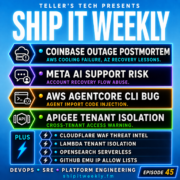
This episode of Ship It Weekly discusses critical infrastructure failures and their implications. Brian analyzes Coinbase's outage due to an AWS cooling failure, Meta's AI-driven account recovery issues, and vulnerabilities in AWS AgentCore and Google Apigee.
Now Playing
Coinbase Outage, Meta AI Account Recovery, AWS AgentCore Code Injection, Apigee Tenant Isolation, and the Glue That Breaks Production
Ship It Weekly
0:0023:11
Chapters
Jump to a section in this episode.
Speed & share
Transcript
An AWS data hall overheats. A single availability
zone goes dark. And Coinbase spends hours recovering
systems that were not as failure-independent
as everyone hoped. Meta's AI support tooling
becomes part of an Instagram account recovery
path. And suddenly the chatbot is not just helping
customers. It is touching identity. AWS has another
agent tooling bug, this time in AgentCore CLI.
where imported agent metadata could become generated
Python code. And Google Cloud disclosed an Apigee
cross-tenant issue, which is exactly the kind
of phrase that makes cloud engineers sit up a
little straighter. The theme this week is simple.
The risky part of modern infrastructure is not
always the big obvious production system. Sometimes
it is the glue, the recovery path, the support
workflow, the generated file. the tenant boundary.
The thing everybody depends on, but nobody quite
treats like production until it breaks. I'm Brian
Teller from Teller's Tech, and this is Ship It
Weekly. Welcome back to Ship It Weekly, the show
where we look at the DevOps, SRE, cloud, platform,
and security stories that actually matter when
you are the person who eventually has to keep
the thing running. This week, we're starting
with Coinbase's May 7th outage postmortem. Then
we'll talk about Meta's AI support incident,
where attackers reportedly hijacked Instagram
accounts through an AI-assisted recovery flow.
After that, we'll get into AWS AgentCore CLI
CVE-2026-11393, where collaborator metadata
could break out into generated Python code. Then
we'll talk about Google Cloud Apigee and a cross
-tenant vulnerability, because tenant isolation
is one of those cloud promises you only think
about when it fails. In the lightning round,
we'll hit Cloudflare threat intelligence in WAF
rules, AWS Lambda tenant isolation with event
source mappings, the next generation of
OpenSearch Serverless, and GitHub Enterprise Managed
Users IP allow list coverage. So let's get into
it. First up, Coinbase published a postmortem
for its May 7th outage. And this one is worth
reading if you work anywhere near SRE, platform,
cloud, infrastructure, Kafka, financial systems,
or any system where people say we're multi-AZ
and then everyone quietly hopes that means what
they think it means. Coinbase says that trading,
deposits, withdrawals, and most customer -facing
services were unavailable or degraded for roughly
eight hours. Full recovery took even longer.
The initiating event was physical. Multiple chiller
units failed in a single AWS us-east-1 data hall,
specifically availability zone use1-az4. That
cooling issue triggered a thermal safety shutdown
of affected racks, taking EC2 instances and EBS
volumes in that building offline. That is the
part that looks like a classic cloud outage story.
Something physical breaks inside a data center
and cloud resources disappear. But the more useful
lesson is what happened next. Because most of
us already know that an availability zone can
fail. At least in theory. We have all seen the
diagram. Three boxes, three AZs, nice clean arrows,
everybody nods. Then a real failure happens,
and the system has to prove whether those boxes
were architecture or just decoration. For Coinbase,
one major issue was that the matching engine
was tied closely to the failed zone. And this
is where the nuance matters. Low latency systems
often make tradeoffs that normal apps do not.
If you need extremely tight latency, deterministic
behavior, and careful state handling, you may
choose a design that favors performance over
easy failover. And that is not automatically
irresponsible. But it does mean the recovery
path has to be real, not theoretical. Not we
documented it once. Real. Tested. Owned. Practiced.
Known by more than one person. The other big
lesson is state. Coinbase called out delays around
managed Kafka recovery. And that is extremely
relatable. During an outage, stateless compute
is usually the easy part. You restart it. You
move it. You scale it. You reroute around it.
Then you hit the system with state, ordering,
offsets, replication, partitions, or money-adjacent
semantics, and everything slows down. That is
where incidents get complicated. The app might
be multi-AZ, but what about the broker? The
database? The cache? the topic, the volume, the
thing that keeps the system honest. That is the
real test. The operator takeaway here is simple.
Do not let multi-AZ become a comfort phrase.
Find the parts of your system that are still
effectively tied to one zone, one stateful dependency,
or one recovery path, especially the low-latency
pieces, the Kafka pieces, the databases, the
matching engines, the services with ordering,
offsets, or money adjacent semantics. Then ask
the annoying question, what happens if that AZ
disappears? What depends on recovering in place?
What can actually fail over? How long does it
take? And when was the last time we proved it?
Because resilience is not where the diagram says
the boxes are. It is where the system can actually
recover when one of those boxes disappears. Second
story, Meta confirmed an incident involving its
AI-assisted Instagram support flow. where more
than 20 ,000 accounts were likely impacted. The
reported issue was that attackers could use Meta's
AI support tooling to trigger password reset
links to an email address that was not actually
associated with the victim's account. Meta described
it as a bug where the system did not properly
verify that the provided email matched the email
on the Instagram account. So attackers could
receive reset links for accounts they did not
own. Now, I know what you might be thinking.
Instagram accounts do not sound like a normal
DevOps or SRE story. But the real story is not
social media accounts got hacked. The real story
is this. AI support automation became part of
an identity recovery control plane. And that
is absolutely our lane. Account recovery is privileged
infrastructure. It is the break-glass path for
identity it can reset passwords it can change
emails it can bypass parts of the normal login
path when the user needs help that means it has
power and if ai can influence that workflow then
the ai is not just answering support questions
anymore it is participating in an identity decision
This episode is about the hidden glue holding production together.
That phrase kept coming up while I was looking at this week’s stories. Not because the stories are all the same, but because the failure pattern underneath them feels familiar.
The thing that breaks production is not always the big obvious service.
Sometimes it is the recovery path.
The support workflow.
The generated file.
The tenant boundary.
The async event path.
The admin console.
The logs.
The thing between two systems that quietly decides what is allowed to happen next.
Coinbase’s May 7 outage is the cleanest SRE example. The starting point was physical: multiple chiller failures in a single AWS us-east-1 data hall, which led to a thermal safety shutdown affecting EC2 and EBS resources in one availability zone.
That part is important, but it is not the whole lesson.
Most teams already know an availability zone can fail. We all have the diagram. Three boxes, three AZs, clean arrows, nice labels, everyone nods.
The real question is whether the system can actually recover when one of those boxes disappears.
Coinbase’s postmortem is useful because it shows how quickly the conversation moves from “an AZ failed” to “what was actually coupled to that AZ?” Low-latency systems, stateful dependencies, managed Kafka recovery, ordering, offsets, recovery paths, and failover assumptions all start to matter very quickly.
That is the part worth taking back to your own environment.
Do not let “multi-AZ” become a comfort phrase.
Find the parts of the system that are still effectively tied to one zone, one stateful dependency, or one recovery path. Especially the low-latency pieces, Kafka pieces, databases, matching engines, and services with ordering or money-adjacent semantics.
Then ask the annoying questions.
What happens if that AZ disappears?
What has to recover in place?
What can actually fail over?
How long does recovery take?
And when was the last time anyone proved it?
That is where resilience becomes real.
The Meta AI support story is a different kind of glue, but the same theme. On the surface, it sounds like a consumer social media incident. Instagram accounts, password resets, account recovery.
But the platform angle is much more interesting.
AI support automation became part of an identity recovery control plane.
That matters because account recovery is privileged infrastructure. It can reset passwords, change emails, bypass parts of the normal login path, and help users regain access when the normal flow fails.
That means it has power.
So when AI is added to that workflow, the question is not just whether the answer is helpful. The question is what the workflow can actually do.
Can it only summarize?
Can it route tickets?
Can it recommend next steps?
Can it trigger actions?
Can it change trust?
Can it move an account recovery flow forward?
Those are very different risk profiles.
The takeaway is not “AI support is bad.” The takeaway is that support workflows can be production control planes, especially when they touch identity.
Password resets, MFA resets, email changes, support impersonation, admin ownership changes, and account recovery flows are not just customer service features. They are identity control paths.
If AI can influence them, they need real authorization logic, verification, rate limits, abuse detection, audit logs, escalation paths, and blast radius controls.
The scariest AI system in production might not be your coding agent. It might be the support flow that can reset passwords.
The AWS AgentCore CLI story is another version of the same problem. This time the glue is generated code.
The issue was CVE-2026-11393. In short, collaborator metadata from a Bedrock agent import could end up inserted into a generated Python file in a way that allowed code injection.
The important lesson is simple.
Generated code is still code.
That sounds obvious, but teams do not always treat generated code with the same suspicion as handwritten code. Generated files feel like artifacts. Outputs. Something official. Something the tool made, so maybe nobody needs to read it too closely.
But if metadata, instructions, templates, or agent definitions can become executable files, that path needs review.
This is not really a brand-new class of problem. It is the same old family as SQL injection, template injection, shell injection, CI config injection, and YAML templating weirdness.
Different costume, same villain.
The AI angle makes it feel new, but the secure engineering lesson is old: do not turn text into executable context without a hard boundary.
Do not assume metadata is safe because it came from an API.
Do not assume generated code is safe because it came from an official tool.
And do not assume “instructions” are harmless just because they are called instructions.
In agent systems, instructions can become operational inputs. They can shape behavior, move between systems, become config, become prompts, and sometimes become code.
So the practical takeaway is pretty direct. Keep the CLI updated. Inspect generated files before running them in trusted environments. Run agent tooling with limited permissions. And pay attention to what credentials are available if something goes wrong.
Because the blast radius is not just the bug.
The blast radius is what the generated code can access when it runs.
The Apigee story is about tenant isolation, and I kept this one in the episode because the lesson is still useful even though the specific cross-tenant issue comes from Google’s Apigee security bulletins rather than being a brand-new weekly disclosure.
Tenant isolation is one of the deepest assumptions in cloud and SaaS systems.
You have your environment. Other customers have theirs. The provider, or the platform team, keeps those boundaries in place.
That assumption is what lets anyone build on shared infrastructure at all.
But cross-tenant bugs often do not show up only in the obvious request path. They show up in the seams.
Logs.
Analytics.
Dashboards.
Exports.
Admin tools.
Support consoles.
Background jobs.
Search indexes.
The internal paths that still carry customer data.
That is why the Apigee issue is worth talking about. API management can sit close to access logs, analytics, client behavior, API paths, timing, errors, and operational metadata. Cross-tenant access to that kind of data is not just a privacy problem. It can become a reconnaissance problem, a compliance problem, and a customer trust problem.
The takeaway is not “never use managed services.” That would be ridiculous.
The takeaway is that tenant isolation has to be tested beyond the happy path.
Can tenant A see tenant B’s logs?
Can a support view cross the wrong boundary?
Can an analytics query forget tenant context?
Can an async job mix records that should never touch?
Can an export, dashboard, or search index leak data from the wrong tenant?
Those are platform questions.
The lightning round kept the same pattern going.
Cloudflare turning threat intelligence into real-time WAF rules is useful, but once threat intel enters the blocking path, it becomes production change management. Start in visibility mode, watch false positives, stage the rollout, and make sure the logs explain why something was blocked.
AWS Lambda tenant isolation with event source mappings is a reminder that tenant context has to survive async paths. Queues and event systems are where context gets lost, default tenants sneak in, retries behave differently, and batches mix things that should not mix.
OpenSearch Serverless scale-to-zero is a FinOps story, but also an operations story. Serverless does not mean operationally invisible. It means the operational questions moved to cold starts, indexing behavior, latency, cost patterns, and traffic spikes.
And GitHub Enterprise Managed Users IP allow list coverage is another reminder that source control is production infrastructure. Repo access is part of your security boundary, and that boundary keeps moving into identity, network policy, device posture, and enterprise governance.
Different stories.
Same pattern.
Modern reliability and security problems keep showing up in the seams.
Not always the app.
Not always the database.
Not always the obvious critical service.
Sometimes it is the thing between systems that nobody fully owns until it fails.
That is where a lot of real platform work lives now.
Not just making the app scale.
Not just adding another region.
Not just buying a managed service.
But asking where the authority actually sits.
Who can recover an account?
Who can generate code?
Who can access another tenant’s data?
Who carries tenant identity through a queue?
Who owns the failover path?
Who tested the recovery plan?
Who gets paged when the glue fails?
That work is not glamorous, but it is where a lot of production risk hides.
This episode of Ship It Weekly is about the hidden glue holding production together.
Brian covers Coinbase’s May 7 outage postmortem, where an AWS us-east-1 cooling failure exposed the difference between being “multi-AZ” on paper and actually being able to recover when stateful, low-latency systems are tied to a failed zone.
Then he looks at Meta’s AI-assisted Instagram support issue and why account recovery is identity infrastructure, not just customer support. If AI can influence password resets, email changes, MFA resets, or account ownership flows, that workflow needs to be treated like a production control plane.
The episode also covers AWS AgentCore CLI CVE-2026-11393, where collaborator metadata could break out into generated Python code during agent import, and an Apigee cross-tenant issue from Google’s Apigee security bulletins that shows why tenant isolation has to be tested beyond the obvious happy path.

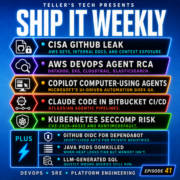
This episode is about the hidden glue holding production together.
That phrase kept coming up while I was looking at this week’s stories. Not because the stories are all the same, but because the failure pattern underneath them feels familiar.
The thing that breaks production is not always the big obvious service.
Sometimes it is the recovery path.
The support workflow.
The generated file.
The tenant boundary.
The async event path.
The admin console.
The logs.
The thing between two systems that quietly decides what is allowed to happen next.
Coinbase’s May 7 outage is the cleanest SRE example. The starting point was physical: multiple chiller failures in a single AWS us-east-1 data hall, which led to a thermal safety shutdown affecting EC2 and EBS resources in one availability zone.
That part is important, but it is not the whole lesson.
Most teams already know an availability zone can fail. We all have the diagram. Three boxes, three AZs, clean arrows, nice labels, everyone nods.
The real question is whether the system can actually recover when one of those boxes disappears.
Coinbase’s postmortem is useful because it shows how quickly the conversation moves from “an AZ failed” to “what was actually coupled to that AZ?” Low-latency systems, stateful dependencies, managed Kafka recovery, ordering, offsets, recovery paths, and failover assumptions all start to matter very quickly.
That is the part worth taking back to your own environment.
Do not let “multi-AZ” become a comfort phrase.
Find the parts of the system that are still effectively tied to one zone, one stateful dependency, or one recovery path. Especially the low-latency pieces, Kafka pieces, databases, matching engines, and services with ordering or money-adjacent semantics.
Then ask the annoying questions.
What happens if that AZ disappears?
What has to recover in place?
What can actually fail over?
How long does recovery take?
And when was the last time anyone proved it?
That is where resilience becomes real.
The Meta AI support story is a different kind of glue, but the same theme. On the surface, it sounds like a consumer social media incident. Instagram accounts, password resets, account recovery.
But the platform angle is much more interesting.
AI support automation became part of an identity recovery control plane.
That matters because account recovery is privileged infrastructure. It can reset passwords, change emails, bypass parts of the normal login path, and help users regain access when the normal flow fails.
That means it has power.
So when AI is added to that workflow, the question is not just whether the answer is helpful. The question is what the workflow can actually do.
Can it only summarize?
Can it route tickets?
Can it recommend next steps?
Can it trigger actions?
Can it change trust?
Can it move an account recovery flow forward?
Those are very different risk profiles.
The takeaway is not “AI support is bad.” The takeaway is that support workflows can be production control planes, especially when they touch identity.
Password resets, MFA resets, email changes, support impersonation, admin ownership changes, and account recovery flows are not just customer service features. They are identity control paths.
If AI can influence them, they need real authorization logic, verification, rate limits, abuse detection, audit logs, escalation paths, and blast radius controls.
The scariest AI system in production might not be your coding agent. It might be the support flow that can reset passwords.
The AWS AgentCore CLI story is another version of the same problem. This time the glue is generated code.
The issue was CVE-2026-11393. In short, collaborator metadata from a Bedrock agent import could end up inserted into a generated Python file in a way that allowed code injection.
The important lesson is simple.
Generated code is still code.
That sounds obvious, but teams do not always treat generated code with the same suspicion as handwritten code. Generated files feel like artifacts. Outputs. Something official. Something the tool made, so maybe nobody needs to read it too closely.
But if metadata, instructions, templates, or agent definitions can become executable files, that path needs review.
This is not really a brand-new class of problem. It is the same old family as SQL injection, template injection, shell injection, CI config injection, and YAML templating weirdness.
Different costume, same villain.
The AI angle makes it feel new, but the secure engineering lesson is old: do not turn text into executable context without a hard boundary.
Do not assume metadata is safe because it came from an API.
Do not assume generated code is safe because it came from an official tool.
And do not assume “instructions” are harmless just because they are called instructions.
In agent systems, instructions can become operational inputs. They can shape behavior, move between systems, become config, become prompts, and sometimes become code.
So the practical takeaway is pretty direct. Keep the CLI updated. Inspect generated files before running them in trusted environments. Run agent tooling with limited permissions. And pay attention to what credentials are available if something goes wrong.
Because the blast radius is not just the bug.
The blast radius is what the generated code can access when it runs.
The Apigee story is about tenant isolation, and I kept this one in the episode because the lesson is still useful even though the specific cross-tenant issue comes from Google’s Apigee security bulletins rather than being a brand-new weekly disclosure.
Tenant isolation is one of the deepest assumptions in cloud and SaaS systems.
You have your environment. Other customers have theirs. The provider, or the platform team, keeps those boundaries in place.
That assumption is what lets anyone build on shared infrastructure at all.
But cross-tenant bugs often do not show up only in the obvious request path. They show up in the seams.
Logs.
Analytics.
Dashboards.
Exports.
Admin tools.
Support consoles.
Background jobs.
Search indexes.
The internal paths that still carry customer data.
That is why the Apigee issue is worth talking about. API management can sit close to access logs, analytics, client behavior, API paths, timing, errors, and operational metadata. Cross-tenant access to that kind of data is not just a privacy problem. It can become a reconnaissance problem, a compliance problem, and a customer trust problem.
The takeaway is not “never use managed services.” That would be ridiculous.
The takeaway is that tenant isolation has to be tested beyond the happy path.
Can tenant A see tenant B’s logs?
Can a support view cross the wrong boundary?
Can an analytics query forget tenant context?
Can an async job mix records that should never touch?
Can an export, dashboard, or search index leak data from the wrong tenant?
Those are platform questions.
The lightning round kept the same pattern going.
Cloudflare turning threat intelligence into real-time WAF rules is useful, but once threat intel enters the blocking path, it becomes production change management. Start in visibility mode, watch false positives, stage the rollout, and make sure the logs explain why something was blocked.
AWS Lambda tenant isolation with event source mappings is a reminder that tenant context has to survive async paths. Queues and event systems are where context gets lost, default tenants sneak in, retries behave differently, and batches mix things that should not mix.
OpenSearch Serverless scale-to-zero is a FinOps story, but also an operations story. Serverless does not mean operationally invisible. It means the operational questions moved to cold starts, indexing behavior, latency, cost patterns, and traffic spikes.
And GitHub Enterprise Managed Users IP allow list coverage is another reminder that source control is production infrastructure. Repo access is part of your security boundary, and that boundary keeps moving into identity, network policy, device posture, and enterprise governance.
Different stories.
Same pattern.
Modern reliability and security problems keep showing up in the seams.
Not always the app.
Not always the database.
Not always the obvious critical service.
Sometimes it is the thing between systems that nobody fully owns until it fails.
That is where a lot of real platform work lives now.
Not just making the app scale.
Not just adding another region.
Not just buying a managed service.
But asking where the authority actually sits.
Who can recover an account?
Who can generate code?
Who can access another tenant’s data?
Who carries tenant identity through a queue?
Who owns the failover path?
Who tested the recovery plan?
Who gets paged when the glue fails?
That work is not glamorous, but it is where a lot of production risk hides.
So the takeaway from this episode is simple:
Do not just review the big production systems.
Review the seams.
That is usually where the incident is waiting.
Extra links worth including on the episode page:
Coinbase May 7 outage postmortem
https://www.coinbase.com/blog/a-postmortem-of-our-may-7-2026-outage
Meta AI support / Instagram account recovery reporting
https://www.theverge.com/tech/945658/meta-ai-support-chatbot-exploit-instagram-accounts
AWS AgentCore CLI CVE-2026-11393
https://aws.amazon.com/security/security-bulletins/2026-040-aws/
AgentCore CLI GitHub advisory
https://github.com/aws/agentcore-cli/security/advisories/GHSA-m4x6-gwgp-4pm7
Google Apigee security bulletins
https://docs.cloud.google.com/apigee/docs/security-bulletins/security-bulletins
Cloudflare real-time threat intel WAF rules
https://blog.cloudflare.com/realtime-threat-intel-waf-rules/
AWS Lambda tenant isolation with event source mappings
https://aws.amazon.com/blogs/compute/integrating-event-source-mappings-with-aws-lambda-tenant-isolation-mode/
Amazon OpenSearch Serverless next generation
https://aws.amazon.com/about-aws/whats-new/2026/05/amazon-opensearch-serverless-next-generation-generally-available/
GitHub Enterprise Managed Users IP allow list coverage
https://github.blog/changelog/2026-06-08-ip-allow-list-coverage-for-emu-namespaces-in-general-availability/
This week’s On Call Brief
https://learn.tellerstech.com/on-call-brief-news/2026-W24/
More Ship It Weekly episodes
https://shipitweekly.fm/