Reach engineers who run production
Ship It Weekly is a focused DevOps, SRE, platform and cloud engineering show for people close to infrastructure, reliability, delivery, and cloud operations. It is built around signal, operator trust, and sponsor fit instead of broad consumer reach.
Ship It Weekly
Weekly commentary on incidents, launches, outages, security issues, and production lessons for teams who operate the systems everyone else depends on.
Recent evidence that supports the sponsor story
Narrow, source-backed snapshots — not permanent claims about ranking, scale, or endorsement.
Framed per qualified listener, not as raw CPM
Raw effective CPM on a niche B2B technical podcast is mathematically high because the audience is filtered narrow on purpose. The number that matches the buying decision is cost per qualified listener — what does each senior DevOps, SRE, or platform engineer reached actually cost?
Benchmark CPM ranges are drawn from the IAB / PwC Podcast Advertising Revenue Study and publicly reported marketplace pricing (AdvertiseCast). Per-listener and per-episode numbers above are derived live from the catalog so they stay in step with the rate card and recent reach.
Apple Podcasts chart positions and category visibility.
Keyword rankings across Apple Podcasts, Spotify, Amazon Music, and YouTube Music.
Curated platform features and editorial spotlights. Lower because the show is independent and earns visibility through content rather than platform features.
Built for signal, trust, and relevance
Not mass-market scale — trusted access to working engineers and technical leaders who care about production systems.
Operator trust
The show is hosted from a working-practitioner perspective, which makes sponsor messages land closer to peer recommendation than generic ad inventory.
Category relevance
Ship It Weekly is built for DevOps, SRE, platform and cloud engineering, infrastructure, and security-adjacent teams rather than broad consumer tech audiences.
Discovery beyond release day
Episodes, show pages, search presence, and clips keep working after the initial drop, which helps sponsors stay discoverable beyond one listen.
Multi-surface presence
Sponsors can show up across audio, video, website placement, episode pages, email episode alerts, and the broader Teller's Tech / On Call Brief ecosystem.
On Call Brief co-promotion
Every episode sponsor automatically gets a “Sponsored by” credit — a small byline in that week's On Call Brief email and on the brief page — putting your brand in front of the newsletter audience at no extra cost. A full, dedicated ad placement inside a brief is available as a paid add-on.
Episode-alert email
When a new episode drops, subscribers get a Ship It Weekly episode-alert email — and the sponsor's “Sponsored by” line rides along in it, adding a direct-inbox touchpoint alongside the audio and web placements at no extra cost.
Who this show is actually for
Intentionally narrow — technical practitioners, reliability-minded teams, and people who influence what gets adopted in engineering orgs.
Estimated age signal
Directional audience data suggests the core listener base skews toward ages 25–44, which aligns well with working engineers and technical decision influencers.
Estimated gender mix
Directional podcast-audience tooling suggests a mix around 60% male and 40% female, which is more balanced than many technical media properties.
Regional concentration
Recent analytics and directional tools point to North America and Europe as the strongest listening regions for the show.
Recurring audience signal
Directional third-party audience data suggests recurring reach among technical listeners, supporting the show’s consistency with a niche B2B engineering audience.
What the audience actually shows up for
Topics across the published catalog, ranked by how often each area is covered. Higher coverage signals deeper editorial fit for sponsors selling into that category.
Weekly cadence, proven over six months
Each dot is one calendar week (Sunday–Saturday) since launch on November 20, 2025 — the show's actual run, week by week. Filled dots mark weeks where a regular episode shipped: visible, measurable consistency rather than a promise. Darker dots mark weeks with more than one release. Empty dots are weeks where no regular episode shipped — visible rather than smoothed over.
Episode shipped in 34 of 42 weeks. 19 of those weeks had more than one release.
Methodology: a calendar week reads as filled when any regular episode shipped during it, including Ship It Conversations releases; darker dots are weeks with two or more releases. Calendar weeks run Sunday to Saturday; trailers and specials excluded.
Where each covered topic sits on the engineering map
Bubble size is real coverage — the count of episodes touching that topic. Position is a qualitative read: how fast-moving the topic is (X) and how operationally heavy it is in production (Y).
One sponsor message, multiple touchpoints
A single sponsorship doesn't sit alone on the audio feed. The same message rides through video, episode-page web copy, social cutdowns, the Ship It Weekly episode-alert email, and the On Call Brief newsletter — reinforcing in places the audience already trusts.
DevOps and platform engineers
Operators looking for signal on CI/CD, cloud infrastructure, incidents, developer platforms, and the tooling choices that matter in production.
SRE and reliability-minded teams
Listeners who care about outages, operational lessons, resilience patterns, and the tradeoffs that show up once real systems are under load.
Technical decision influencers
Senior ICs, architects, and engineering leaders who evaluate tools, influence standards, and help shape what gets adopted across a team.
Security-conscious builders
The audience consistently overlaps with cloud security, software supply chain, identity, and platform-risk conversations rather than generic consumer tech.
Practitioners who have actually shipped
The show regularly hosts guests who run production, lead platform teams, or build the tools sponsors sell into. A campaign here lands next to real operator voices, not a generic interview funnel.
Where the audience actually listens
Snapshot from RSS.com analytics, June 2026 — the recent monthly window of direct downloads, running at roughly 3,000 downloads a month. That recent pace is what built the cumulative-since-launch total (17,690 downloads in just over six months, 334+ per episode) surfaced in the proof section above.
Top countries
Share of recent downloads by listener country.
Plus 19+ more countries with recurring downloads. North America and Europe together are roughly 80% of the listener base.
Device & platform mix
How the audience consumes the show.
Among phone listeners specifically, 81% are on iPhone — a strong indicator of senior-engineer / premium-device skew typical of US, UK, and EU technical audiences.
Smartwatch listening (1%+) is a small but growing surface that suggests in-context, on-the-go consumption during work commutes and incidents.
Top listening apps
Where podcast-app listens come from.
Overcast running neck-and-neck with Apple Podcasts is a recognizable engineering-audience signal — Overcast is the power-user choice for technical listeners. Spotify and YouTube Music in-app plays are counted on those platforms separately, and browser / web-player direct downloads are excluded here, so the mix reflects dedicated podcast apps.
Owned-media reach
A campaign on Ship It Weekly can be amplified through adjacent owned channels where the same engineering audience already follows the show.
More than a single host-read slot
Strongest when a sponsor message appears where technical buyers already spend attention: the show, the video companion, episode pages, and owned-media surfaces.
Audio podcast
Host-read placement in the core weekly show for engineers who want concise signal on production systems and platform tooling.
Video episode
YouTube and companion video placement creates an additional sponsor surface for visual branding, links, and repeated exposure.
Owned web presence
Episode pages, sponsor-aligned landing pages, and searchable site content keep sponsor messaging tied to discoverable technical content.
Email episode alerts
Subscribers get a Ship It Weekly email when each episode drops, and the sponsor line rides along — a direct-inbox touchpoint beyond audio and web.
Extended ecosystem
Short-form clips, LinkedIn-friendly amplification, and the adjacent On Call Brief property give the right sponsor more than one context to appear in.
Recent sponsors
See sponsorship in context
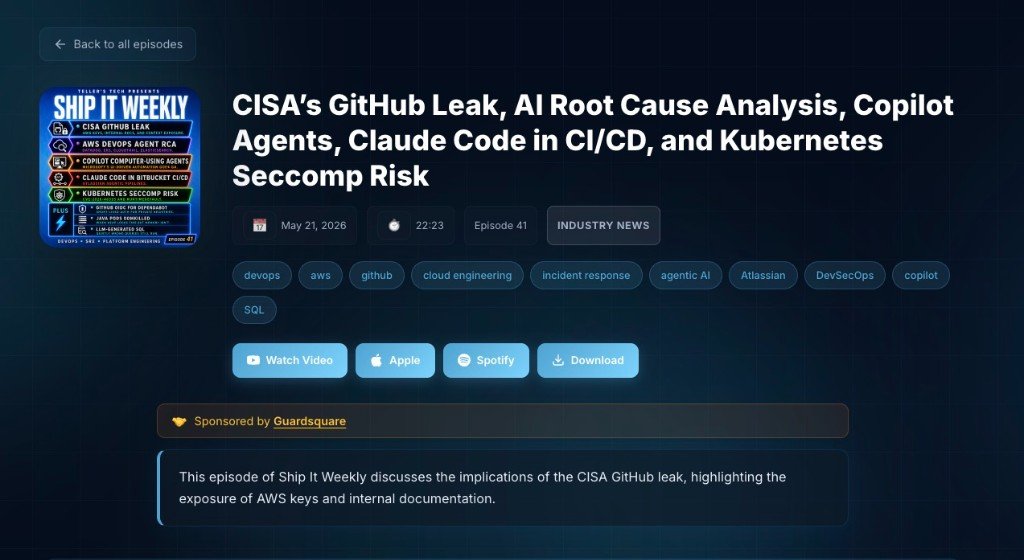
A representative example from a live episode — Episode 41 (May 2026) shows exactly where a sponsor lands. Guardsquare gets a card directly above the fold next to the listen CTAs, plus a click-through inline mention inside the show notes. Every regular episode follows the same pattern, including the most recent.
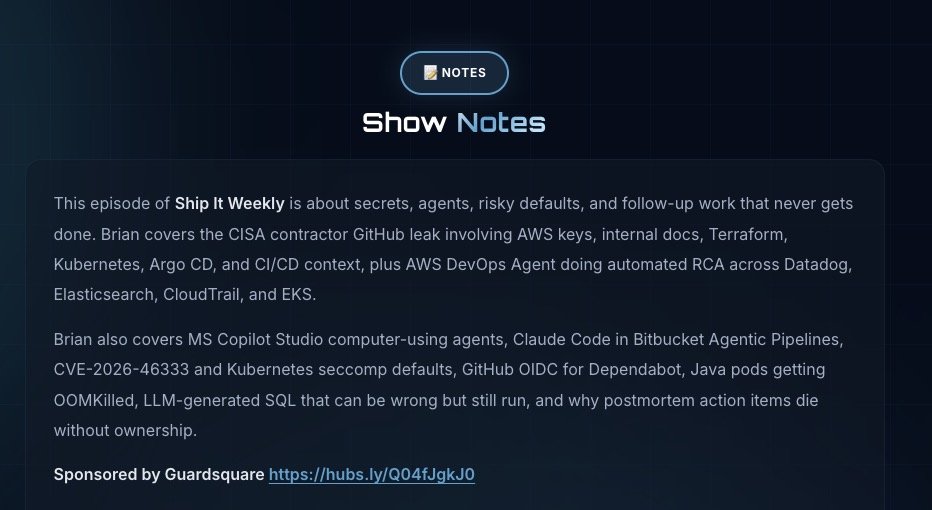
Plus a host-read mention woven into the episode itself — typically 30–60 seconds, delivered in-segment so it lands as part of the show rather than as a cut-away ad break.
Episode 41: CISA's GitHub leak, AI root-cause analysis, Copilot agents, Claude Code in CI/CD, and Kubernetes seccomp risk. View the live episode page →
What the show is covering right now
Sponsor alignment stays tied to live engineering conversations — incidents, launches, security stories, platform tradeoffs — not generic tech news.
EKS Rollbacks, GitHub Actions Supply Chain Attacks, AI Agentjacking, CloudWatch Log Alarms, and Why Safety Nets Don’t Replace Ownership
This week on Ship It Weekly: Amazon EKS added Kubernetes version rollbacks, Novee Security published Cordyceps research on GitHub Actions supply chain risk, Tenet Security showed how fake telemetry can hijack AI coding agents,…
Ship It Conversations: Evan Phoenix of Miren on Deployment Pain, Terraform, Waypoint, and Better Defaults for Small Teams
This is a guest conversation episode of Ship It Weekly, separate from the weekly news recaps.In this Ship It: Conversations episode, I talk with Evan Phoenix of Miren about why deployment is still painful,…
Amazon Q CVEs, Hijacked npm and Go Packages, AWS WAF HTTP/2 Issues, Lambda MicroVMs, and Why Execution Is the Boundary Now
This week on Ship It Weekly: Amazon Q Developer and the AWS language servers had a pair of trust-boundary CVEs, JFrog found hijacked npm and Go packages using hidden VS Code tasks to run…
Ship It Conversations: Kat Traxler of Vectra AI on AI Security, the Zero-Day Clock, IAM, and Cloud Risk
This is a guest conversation episode of Ship It Weekly, separate from the weekly news recaps.In this Ship It: Conversations episode, I talk with Kat Traxler of Vectra AI about AI security, the zero-day…
containerd CRI Vulnerabilities, Datadog PostgreSQL HA on Kubernetes, AWS DevOps Agent with Datadog MCP Server, EKS Control Plane Egress, and Why Users Feel the Wait
This week on Ship It Weekly: containerd disclosed a batch of CRI plugin vulnerabilities, Datadog tested PostgreSQL high availability on Kubernetes and found that failover is not useful if it cannot happen safely, AWS…
Ship It Conversations: Guardsquare’s Joel DeStefano on Mobile App Security, Runtime Protection, App Hardening, and Why Scanning Isn’t Enough
This is a guest conversation episode of Ship It Weekly, separate from the weekly news recaps.In this Ship It: Conversations episode, I talk with Joel DeStefano from Guardsquare about mobile app security, why it…
The show also publishes supporting updates through show-news posts and owned web surfaces, which helps sponsor-aligned content stay discoverable outside the main episode feed.
How often each area gets coverage
Counts are episode appearances across every published episode (titles and show notes). Most episodes touch multiple areas, so totals overlap.
Top episodes by cumulative downloads
RSS.com analytics · June 2026 exportMetrics refreshed quarterly or before each sponsor conversation.
A snapshot of recurring breakouts in the catalog. Most recent releases settle around the 300-500 download mark; these are the titles that broke higher and continue to draw long-tail traffic.
Fail Small, IaC Control Planes, and Automated RCA
Ship It Conversations: Backstage vs Internal IDPs, and Why DevEx Muscle Matters (with Danny Teller)
Special: Claude Mythos Preview and Project Glasswing: AI Exploit Discovery, Zero-Day Risk, Business Fallout, and What It Means for DevOps, Cloud, and Platform Security
n8n Critical CVE (CVE-2026-21858), AWS GPU Capacity Blocks Price Hike, Netflix Temporal
GitHub Agentic Workflows, Gentoo Leaves GitHub, Argo CD 3.3 Upgrade Gotcha, AWS Config Scope Creep
Kubernetes 1.36, Gateway API v1.5, AWS Copilot End of Support, and Cloudflare Non-Human Identities
Great for technical vendors. Not generic consumer ads.
Strongest fit: product categories an infrastructure, reliability, security, or platform team would actually evaluate or trial in production.
Best-fit categories
Why that matters
Ship It Weekly works best as high-trust technical inventory. The value is relevance, repeat exposure, and credibility with teams evaluating real infrastructure decisions.
- Better fit than broad, low-intent reach.
- Strongest when the sponsor solves a real problem for technical teams.
Single episode placement
Best for launches, experiments, or a first campaign with concise sponsor messaging across the episode and companion surfaces.
Multi-episode campaign
Better for recall, trust, and repetition. Technical audiences usually need to hear a message more than once before it sticks.
Custom ecosystem package
For strong sponsor fit, campaigns can pair podcast placement with video, site visibility, and adjacent owned-media touchpoints.
Public card rates for campaign planning
Rates set expectations for strong-fit technical sponsors. Multi-episode campaigns are preferred — repetition matters with engineering audiences.
| What you get | Single episode $750 | Most chosen3-episode campaign $1,950 | 6-episode campaign $3,300 |
|---|---|---|---|
| Host-read audio placement | 1 episode | 3 episodes | 6 episodes |
| YouTube video companion | ✓ | ✓ | ✓ |
| Episode show-notes mention | ✓ | ✓ | ✓ |
| Episode page card on the web | ✓ | ✓ | ✓ |
| Per-episode brand exclusivity | ✓ | ✓ | ✓ |
| Episode-alert email "Sponsored by" credit | ✓ | ✓ | ✓ |
| On Call Brief "Sponsored by" credit | ✓ | ✓ | ✓ |
| Dedicated ad placement in an On Call Brief | — | Optional add-on | 1 included |
| Sponsor-supplied creative ok | ✓ | ✓ | ✓ |
| Evergreen placement (no roll-off) | ✓ | ✓ | ✓ |
The On Call Brief “Sponsored by” credit is a small automatic byline in the weekly brief and its email (included on every tier). A dedicated ad placement is a full sponsor slot inside a brief issue — an optional add-on on the 3-episode tier, with one included on the 6-episode tier.
Custom packages are available on request and typically pair audio with video, web visibility, and On Call Brief placements. Talk through a fit on the sponsorship contact form.
Inventory is limited by design. Only one sponsor rides each episode, so slots are genuinely finite — if you have target dates or a launch to line up against, share them early and we’ll try to hold the window.
Selective sponsor fit
The goal is strong alignment with infrastructure, security, developer platform, and reliability products rather than generic creator-ad inventory.
Technical credibility matters
Sponsor messaging should sound like it belongs in an engineering conversation, with clear relevance to production systems and operational work.
Evergreen visibility beats hype
The show aims for repeated exposure through episodes, video, and owned web surfaces instead of one short-lived vanity spike.
Recent snapshots, not stale bragging
Public proof points should be recent, dated, and source-backed. Fuller current numbers, examples, and package details can be shared directly during sponsorship conversations.
Creative specs & timeline
Everything you need to brief your team and plan a launch window — no back-and-forth required.
Trusted because it sounds like it comes from someone who has been there

Brian Teller
Brian is the host of Ship It Weekly and the builder behind Teller's Tech, a media and training platform focused on DevOps, SRE, platform engineering, cloud infrastructure, and the real-world work of keeping production systems alive.
Brian started Ship It Weekly because most tech news says what happened—but not always why it matters to the people on-call when the headline becomes their incident.
Sponsor questions, answered
What kinds of sponsors fit best?
The strongest fit is B2B technical vendors in cloud, infrastructure, observability, platform engineering, security, CI/CD, and adjacent categories that solve real problems for production teams.
Do you offer custom packages?
Yes. The best campaigns are usually tailored around the sponsor's product, target audience, and whether the goal is awareness, launch visibility, or repeated presence across multiple episodes.
What's the typical lead time?
Plan on roughly three to four weeks from signed agreement to the first live episode. That covers package alignment, ad copy or talking-point review, recording into the next episode's production cycle, and publication. Faster turnarounds are sometimes possible for tightly scoped reads.
Can I provide my own ad copy, or is it host-read?
Both work. The default is a host-read placement built from sponsor-supplied talking points so the read sounds native to the show. Sponsors can also provide a fully written script. Either way, the sponsor reviews the planned read before recording so messaging stays accurate.
Do you offer per-episode sponsor exclusivity?
Yes — per-episode exclusivity is included by default. Only one main sponsor read per episode, so a sponsor never shares an episode with another brand.
Is the YouTube version of the show included?
Yes. The audio sponsor read is included automatically in the YouTube companion at no extra cost. Video-specific creative (lower thirds, on-screen graphics, custom cuts) can be quoted separately when the sponsor wants a richer visual presence.
Are sponsor placements evergreen, or do they roll off after a window?
Yes, every host-read placement is evergreen. The sponsor read stays embedded in the episode permanently, so the long tail keeps delivering exposure long after the campaign window. Several catalog episodes are still earning hundreds of additional downloads months after publication, which means a sponsor read continues to surface in searches, recommendations, and back-catalog plays well beyond the initial release week.
Do you do affiliate or performance deals?
Yes, with tracked URLs or promo codes when the product supports them. The default model is sponsorship rather than performance, but performance arrangements are workable for the right fit, particularly with multi-episode commitments.
Why are there no stale download charts here?
This page prioritizes evergreen fit and carefully labeled proof points over vanity metrics that drift quickly. Where we do show time-sensitive data, it is framed as a recent snapshot rather than a permanent claim.
Can sponsors review copy or talking points?
Yes. The goal is a sponsor message that feels technically credible and aligned with the audience, not a generic script dropped into an engineering show.
Interested in sponsoring Ship It Weekly?
If your product serves DevOps, SRE, platform, infrastructure, or security-conscious engineering teams, we can shape a campaign that feels technically credible, aligned with the audience, and backed by current metrics shared in context.
Prefer email? Reach us directly at tellerstech@gmail.com.